
 st-edge-ai-core

ST Neural-ART NPU - Runtime loadable model support 
Introduction 
What is a runtime loadable model? 
A runtime loadable model, also known as a relocatable binary model, is a binary object that can be installed and executed at runtime within an STM32 memory subsystem. This model includes a compiled version of the generated neural network (NN) C files, encompassing the necessary forward kernel functions and weights/parameters. Its primary purpose is to offer a flexible method for upgrading AI-based applications without the need to regenerate and flash the entire end-user firmware. This approach is particularly useful for technologies such as firmware over-the-air (FOTA). This feature allows the following:
Models and their associated memory contents to be loaded dynamically at runtime.
Flexibility to update or swap models without rebuilding the entire application.
Clear separation between application logic and model data.
The binary object can be seen as a lightweight plug-in, capable of running from any address (position-independent code) and storing its data anywhere in memory (position-independent data). An efficient and minimal dynamic/runtime loader enables the instantiation and usage of this model. Unlike traditional systems, the firmware does not embed a complex and resource-intensive dynamic linker for Arm® Cortex®-M microcontrollers. The generated object is mainly self-contained, requiring limited and well-defined external symbols (NPU runtime dependent) at runtime.
In comparison with the software-only solution (fully self-contained object), the runtime loadable model for the Neural-ART accelerator must be installed inside an NPU runtime software stack. This allows supporting multiple instances, including the static version. No specific synchronization mechanism is embedded in the relocatable part; instead, the scheduling and access to the hardware resources ( NPU subsystem) are managed by the stack itself (static part).
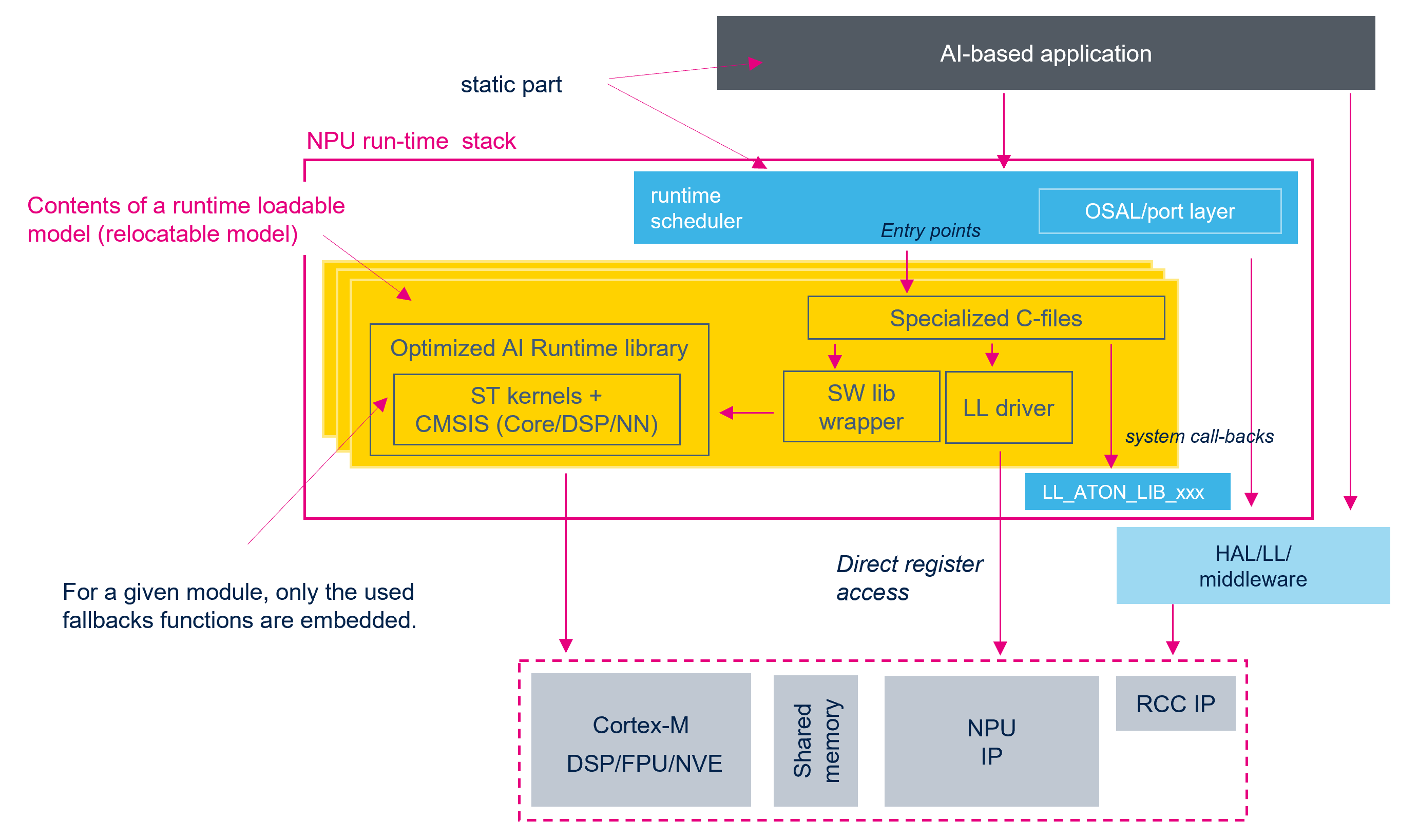
The generated runtime loadable model is a container that includes relocatable code (text, data, and rodata sections) to configure
various neural processing unit (NPU) epochs. It primarily comprises a compiled version (microcontroller unit (MCU)-dependent)
of the specialized
network.c
file, the low-level (LL) ATON driver functions used, and the code for delegated software operations,
which are part of the optimized network runtime library. For hybrid epochs (calls to
LL_ATON_LIB_xxx
functions), a specific
callback-based mechanism is implemented to directly invoke the services of the stack. These system callback functions are provided
by the static part of the NPU stack and are registered during the installation phase of the model
(see the
ll_aton_reloc_install()
function).
Solution overview 
Memory model 
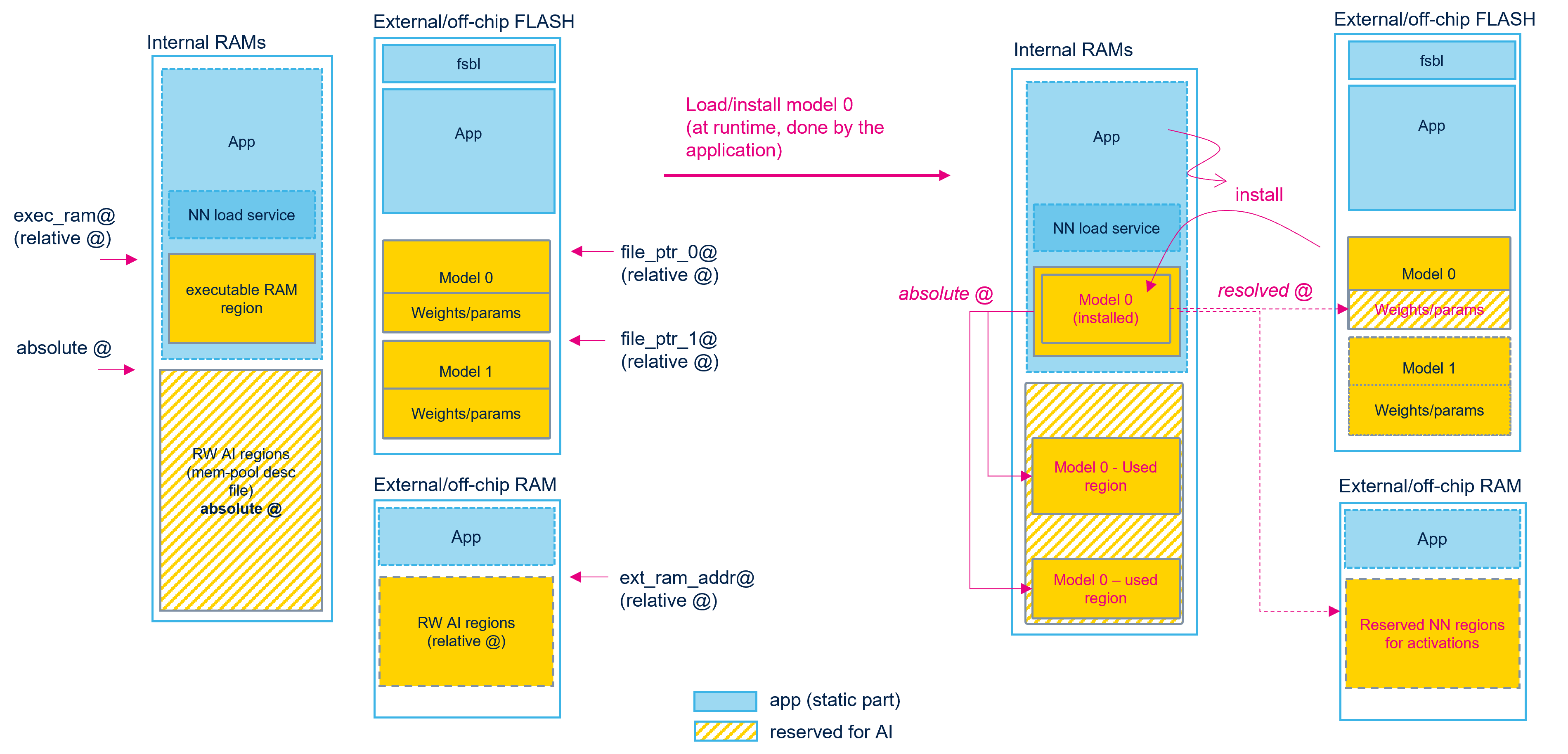
As illustrated in the following figure, to use runtime loadable models, a portion of the internal RAMs (read/write AI regions) is fixed or reserved and has absolute addresses. These regions must not be used by the application during inference. A non-fixed executable RAM region is required to install a given model. This read/write region allows to resolve the relocatable references during the installation process at runtime.
|
Item |
Definition |
|---|---|
|
executable RAM region |
Designates the memory region used to install a model at runtime (txt/data sections). This shared memory-mapped region, located anywhere in the memory subsystem, can be reserved at runtime by the application. The minimum requested size is returned by the ll_aton_reloc_get_info() function ( rt_ram_xip or rt_copy_xip fields). Attributes: MCU RWX, NPU RO. For performance reason, the region should be fully cached (MCU). (*) |
|
RW AI regions |
Designates the memory regions which are reserved for the activations/parameters. Base addresses are absolutes and are defined in the mem-pool descriptor files. Attributes: MCU/NPU memory-mapped, MCU RW, NPU RW. To know/check the memory regions which are used, the ll_aton_reloc_get_mem_pool_desc() can be used. (**) |
|
RW AI region (external RAM) |
If requested, designates the memory regions which are allocated/reserved to place the requested part of the memory-pool defined for the external RAM. The base address can be relative (can be placed anywhere in the external RAM) or absolute. ONLY one relative region is supported, it can be reserved at runtime by the application. The requested size ( ext_ram_sz field) is returned by the ll_aton_reloc_get_info() function. Attributes: MCU RWX, NPU RW (**). |
|
Model X (weights/params) |
Designates the memory regions where the relocatable binary models are stored. Base addresses ( file_ptr) are relative and dependent on the application managing the FOTA-like mechanism. Attributes: MCU/NPU memory-mapped, MCU RO, NPU RO. |
|
App |
Designates the memory regions which are reserved for the application (static part), it embeds a minimal part (NN load service) allowing to load/install and execute a relocatable model. |
(*) This region must be also accessible by the NPU in the case where the epoch controller is enabled.
(**) These regions should be also accessible by the MCU in the case where a operator/epoch is delegated on the MCU.
Limitations 
Only the STM32N6-based series with Neural-ART accelerator is supported.
Addresses of the used internal/on-chip memory-pools are fixed/absolutes (USEMODE_ABSOLUTE attribute). Only the external addresses relative to the off-chip memories: flash and RAM type, can be relocatable/relative (or USEMODE_RELATIVE attribute)
Only two relocatable/relative memory pools are supported. One for RO regions handling the weights/params and another for an external RW memory region. Note that the external RAM region can be also absolute.
Secure mode generation and XIP mode are not supported with ARM clang/llvm toolchain (cmse is not compatible with ROPI/RWPI).
Support for the encrypted weights/params throught the ST Edge AI core CLI is not supported.
Embedded compiler options for relocatable mode 
To generate relocatable objects, according to the Arm® Embedded toolchain used, two sets of compilation options are considered
(see makefiles from the
$STEDGEAI_CORE_DIR/Utilities/scripts/N6_reloc/resources
folder):
For a GCC Arm® Embedded toolchain, all the code, including the network runtime library, is compiled using the -fpic, -msingle-pic-base, and -mno-pic-data-is-text-relative options. The Arm® Cortex®-M r9 register is designated as the platform register for the global offset table (GOT). The primary task of the dynamic/runtime loader is to update the GOT table and the indirect references in the data structure. Both XIP & COPY modes are fully supported.
For a CLANG/LLVM Arm® Embedded toolchain, all the code is compiled with the options -fropi and -frwpi. The r9 register is also used; however, some constant/text parts must also be updated by the dynamic/runtime loader, which does not allow support for the XIP mode.
Prerequisites - Setting up a work environment 
The generation of a runtime-loadable model is integrated into the
ST Edge AI Core command-line interface (CLI).
A specific pass calls the dedicated Python scripts located in the
$STEDGEAI_CORE_DIR/Utilities/scripts/N6_reloc
directory.
The
npu_driver.py
script acts as the entry point for generating the runtime-loadable models, which can be used directly. By default,
a
GNU Arm Embedded tool-chain
supporting the Arm® Cortex® M55 (with the ‘arm-none-eabi-’ prefix)
is used. The user must ensure that the executable is available in the PATH, including a Make utility. The
custom
option allows to customize the enviroment.
%STEDGEAI_CORE_DIR% represents the root location where the ST Edge AI Core components are installed, typically in a path like
"<tools_dir>/STEdgeAI/<version>/".
Using the Python scripts directly
To use the scripts directly, a Python 3.9+ and the following Python modules are requested:
pyelftools==0.27
tabulate
colorama
Note
The Python interpreter available in the ST Edge AI Core pack can be directly used (all requested Python module are already installed).
Optional tools for built-in validation workflow
For validating a runtime loadable model on the STM32N6570-DK board, you may optionally install:
STM32CubeIDE supporting the STM32n6 series (version 1.17.0 or higher)
stm_ai_runner Python package
Note:
'STM32_CUBE_IDE_DIR'
system environment variable must be set to indicate the installation folder fo the STM32CubeIDE pack.
Getting started 
Generating a runtime loadable model 
The
-r/--reloc/--relocatable


             [rel-option]
option allows to generate the runtime-loadable model.
The standard generating workflow is extended with the additional steps to pre-process and compile
the specialized c-files.
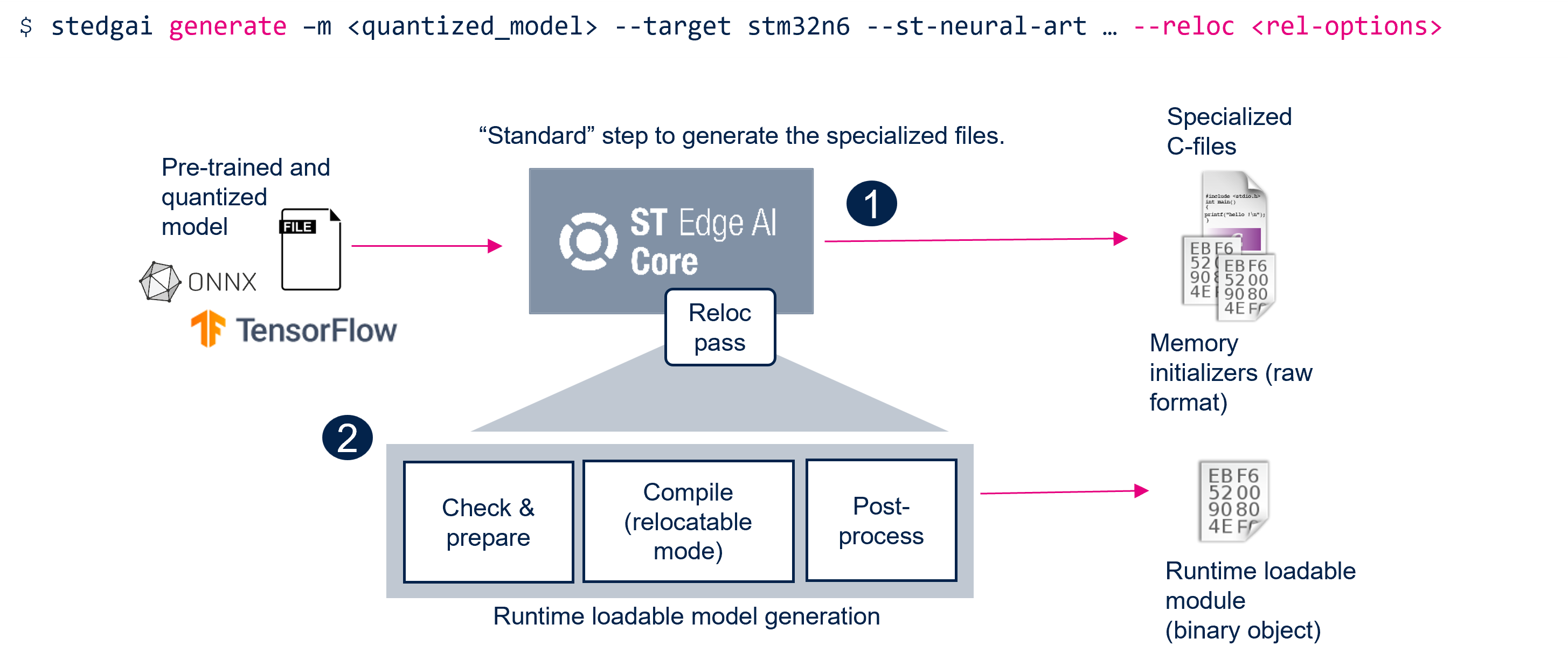
Here is a typical output log example that you might see when running the generate command for an NPU model deployment.
$ stedgeai generate -m <model-name>.tflite/onnx --target stm32n6 --st-neural-art <profile>@<usr_neural_art_reloc>.json --reloc
 ST Edge AI Core v3.0.0
...
 Neural ART - Package for runtime loadable model - v 1.4.0
...
 Generated files (8)
 --------------------------------------------------------------------------------
 <output-directory-path>\<model-name>_OE_3_3_1.onnx
 <output-directory-path>\<model-name>_OE_3_3_1_Q.onnx
 <output-directory-path>\network.c
 <output-directory-path>\network.h
 <output-directory-path>\network_atonbuf.xSPI2.raw
 <output-directory-path>\network_c_info.json
 <output-directory-path>\network_rel.bin
 <output-directory-path>\network_generate_rel.json

Creating report file <output-directory-path>\network_generate_report.txt
Generated files 
|
file |
description |
|---|---|
|
|
The main binary file contains the compiled version of the model, including the forward kernel functions and weights by default. It also embeds additional sections (.header, .got, .rel) to enable the installation of the model. |
|
|
Optional file. If the split parameter is used, the weights are generated in a separated binary file. |
|
|
Extra report file containing the main informations of the generated runtime loadable model (JSON format) |
Note that the memory initializers for the memory regions which are only used for the activations are not requested.
NPU compiler and CLI options 
There are
no restrictions
on the
NPU compiler
options used for this step, except for the usage
of the
--all-buffers-info
option, which provides detailed information about the intermediate and activation buffers. Note that this additional
information is removed during the generation of the runtime loadable model. For the memory-pool descriptor file, the following
attributes are
mandatory:
“mode”: “USEMODE_RELATIVE” for external memory pools only. This is mandatory for the external flash part and optional for the external RAM part. Otherwise, use “USEMODE_ABSOLUTE”.
“fformat”: “FORMAT_RAW” for all memory initializers.
Relocatable options 
The -r/–reloc/–relocatable option can be used with the following parameters. These parameters are mainly forwarded to specialized Python scripts.
|
parameter |
description |
|---|---|
|
<none> |
Default behavior. Generates a single model binary file containing network, kernels, and weights. |
|
“split” |
Generates two separate binary files: one with the model (network + kernels) and another containing only the weights. Useful for flexible memory management. |
|
“gen-c-file” |
Generates the binary file as a C array instead of a raw binary. Mainly for debugging purposes. |
|
“st-clang” |
Use the ST Arm Clang toolchain for compilation instead of the default ARM GCC based toolchain. |
|
“llvm” |
Use the LLVM toolchain for compilation instead of the default ARM GCC based toolchain. |
|
“ecblob-in-params” |
Places the ecblobs (epoch controller blobs) together with the model weights/parameters in the binary. |
|
“no-secure” |
Compile the binary with non-secure flags, useful for non-secure execution environments. Forced behavior with llvm-clang compiler. |
|
“no-dbg-info” |
The LL_ATON_EB_DBG_INFO C-define is not set during the compilation of the model allowing to avoid to embed the debug only information. |
|
“custom[=<usr-file>.json]” |
Use a
custom JSON configuration file
to override default environment settings. If no file is specified, uses
|
The parameters can be combined using a comma separator.
$ stedgeai generate -m -m <model-name>.tflite/onnx <gen_options> ---target stm32n6 -st-neural-art ... --reloc split,gen-c-file
 ...
 <output-directory-path>\network_rel.bin
 <output-directory-path>\network_data.bin
 <output-directory-path>\network_img_rel.c
 <output-directory-path>\network_img_rel.h
“split” parameter 
The
split
option allows generating two separate files. In this case, to deploy the model, both files should be deployed
on the target, and the address of the
"network_rel_params.bin"
should be passed during the installation process at runtime
(see
ll_aton_reloc_install()
function).
“ecblob-in-params” parameter 
The
ecblob-in-params
option indicates that the ecblobs are stored with the params/weights.
This feature allows to reduce the requested exec memory region to execute the model in COPY
mode (see
“Epoch controller consideration”
section).
Ecblobs are placed at the
beginning of the params/weights memory segment.
The
split
option is always supported, the params file includes the ecblobs.
“no-dbg-info” parameter 
The
no-dbg-info
option allows the removal of the
LL_ATON_EB_DBG_INFO
C-define to generate
the runtime loadable model. This option removes debug information, including the intermediate
description of buffers and additional debug fields in the epoch descriptor, thereby reducing
the size of the final binary. These debug details are mandatory for using the built-in validation stack.
“custom” parameter 
The
custom
option allows overriding certain default environment variables used to build the relocatable binary model.
By default a
custom.json
file from the current working directory is used to retrieve the expected values. Alternatively,
the parameter can be extended with a specific file name (for example:
--reloc


               cutsom=myconfog.json
).
|
supported key |
description |
|---|---|
|
“runtime_network_lib” |
Used to indicate the absolute path of the used network runtime library (default: %STEDGEAI_CORE_DIR%/Middlewares/ST/AI/Lib/GCC/ARMCortexM55/NetworkRuntime1100_CM55_GCC_PIC.a) |
|
“extra_system_path” |
Used to prefix the system path allowing to retrieve the used ARM compiler. By default, the arm-none-eabi-gcc executable is used from the PATH |
|
“llvm_install_path” |
llvm
target only. Used to set the
|
|
“target_triplet” |
llvm
target only. Set the
|
|
“llvm_sysroot” |
llvm
target only. Set the
|
Memory layout information 
Below information is reported in the log and also in a well-formatted file in JSON format:
<network>_generate_rel.json.
...
Runtime Loadable Model - Memory Layout (series="stm32n6npu")
--------------------------------------------------------------------------------
v8.0 dbg=True async=True sec=True 'Embedded ARM GCC' cpuid=D22 fpu=True float-abi=2

XIP size             = 3,344      data(2620)+got(708)+bss(16) sections
COPY size            = 32,544     +ro(29200) sections
extra sections       = 1,112      got:708(21.2%) header+rel:404(1.4%)
params size          = 25,713
acts size            = 56,496
binary file size     = 32,832
params file size     = 25,720

+--------------------------+----------------------------------+------+------------+-------+
| name (addr)              | flags                            | foff | dst        | size  |
+--------------------------+----------------------------------+------+------------+-------+
| xSPI2 (0x20004c64)       | 0x01010500 RELOC.PARAM.0.RCACHED | 0    | 0x00000000 | 25713 |
| AXISRAM5 (0x20004c6a)    | 0x03020200 RESET.ACTIV.WRITE     | 0    | 0x342e0000 | 56496 |
| <undefined> (0x00000000) | 0x00000000 UNUSED                | 0    | 0x00000000 | 0     |
+--------------------------+----------------------------------+------+------------+-------+
 Table: mempool c-descriptors (off=40000a00, 3 entries, from RAM)

rt_ctx: c_name="network", acts_sz=56,496, params_sz=25,713, ext_ram_sz=0
rt_ctx: rt_version_desc="atonn-v1.1.3-5-gdabeb3b4d (RELOC.GCC)"
|
item |
description |
|---|---|
|
XIP size |
Size (in bytes) of the executable RAM memory region when using Execute-In-Place (XIP) mode. This is the memory region where code is executed directly without copying. |
|
COPY size |
Size (in bytes) of the executable RAM memory region when using COPY mode, where code or data is copied from non-volatile memory to RAM before execution. |
|
params size |
Total size (in bytes) of the used part of the memory-pools related to the weights and parameters. Detailed information is provided in mempool c-descriptors table. |
|
acts size |
Total size (in bytes) of the used part of the memory-pools related to the activations needed during inference. Detailed information is provided in mempool c-descriptors table. |
|
binary file size |
Size (in bytes) of the generated binary file containing the compiled model and its data. |
|
params file size |
Size (in bytes) of the parameters file when the split option is used to separate weights from the main binary. |
|
rt_ctx / v8.0.. |
Binary header information indicating details such as the Embedded ARM toolchain version used, compilation flags, and other metadata. This header is used by the loader/install function to check if the binary is compliant with the static part of the runtime. |
The “mempool c-descriptors” table indicates the memory regions (part of the user memory-pools) and the flags which are considered by the ll_aton_reloc_install() function at runtime.
|
flag |
description |
|---|---|
|
RELOC |
Indicates a relocatable region, the address (dst=0) will be resolved at runtime during the installation process. |
|
PARAM/ACTIV/MIXED |
Indicates the type of contents: PARAM: params/weights only, ACTIV: activations only, MIXED: mixed |
|
RCACHED/WCACHED |
Indicates that a part of the memory region can be accessible through the NPU cache. RCACHED is associated with a RELOC.PARAM/read-only region |
|
WRITE |
Indicates that the memory region is a read-write memory region. |
|
RESET |
Indicates that the memory region can be cleared if the AI_RELOC_RT_LOAD_MODE_CLEAR option is used. |
|
COPY |
Indicates that the region is initialized/copied during the installation process. |
|
UNUSED |
Last entry in the mempool c-descriptors |
The number 0 or 1 indicates the ID of the relocatable memory regions. Currently, only two regions are supported: 0 for a parameters/weights-only region in external flash and 1 for a read/write memory region in the external RAM.
foff specifies the offset in the parameters/weights section to locate the associated memory initializer when requested.
dst specifies the destination address. If not equal to zero, the address is an absolute address; otherwise, the region is a relocatable region.
size specifies the size in bytes.
Example with a tiny model using only the internal NPU RAM for the activations and weights/params. 
During runtime in the installation process, the AXIRAM2, AXIRAM3, and AXIRAM4 (absolute address) are initialized with the contents of the parameters and weights section. AXIRAM5 is used exclusively for activations.
+--------------------------+------------------------------+------+------------+-------+
| name (addr)              | flags                        | foff | dst        | size  |
+--------------------------+------------------------------+------+------------+-------+
| AXISRAM6 (0x20004c64)    | 0x03020200 RESET.ACTIV.WRITE | 0    | 0x34350000 | 500   |
| AXISRAM5 (0x20004c6d)    | 0x02030200 COPY.MIXED.WRITE  | 0    | 0x342e0000 | 33728 |
| AXISRAM4 (0x20004c76)    | 0x03020200 RESET.ACTIV.WRITE | 0    | 0x34270000 | 40496 |
| AXISRAM3 (0x20004c7f)    | 0x03020200 RESET.ACTIV.WRITE | 0    | 0x34200000 | 16000 |
| <undefined> (0x00000000) | 0x00000000 UNUSED            | 0    | 0x00000000 | 0     |
+--------------------------+------------------------------+------+------------+-------+
 Table: mempool c-descriptors (off=40000428, 5 entries, from RAM)
Example with a model using only the external RAM/FLASH (internal RAMs are not used) 
During runtime in the installation process, the references related to xSPI1 and xSPI2 (relative address) are resolved to the external RAM address (reserved by the application) and the parameters/weights section (part of the installed relocatable module), respectively.
+--------------------------+----------------------------------+------+------------+-------+
| name (addr)              | flags                            | foff | dst        | size  |
+--------------------------+----------------------------------+------+------------+-------+
| xSPI1 (0x20004c62)       | 0x01020601 RELOC.ACTIV.1.WCACHED | 0    | 0x00000000 | 64496 |
| xSPI2 (0x20004c68)       | 0x01010500 RELOC.PARAM.0.RCACHED | 0    | 0x00000000 | 32625 |
| <undefined> (0x00000000) | 0x00000000 UNUSED                | 0    | 0x00000000 | 0     |
+--------------------------+----------------------------------+------+------------+-------+
 Table: mempool c-descriptors (off=40001618, 3 entries, from RAM)
Epoch controller consideration 
There is
no functional limitation
on using the
epoch controller
with the runtime-loadable model.
By default, the generated command streams (also called ecblobs) are stored as constants in the read-only data (rodata) section.
However, as they reference addresses that are not known at generation time (i.e. weights/params buffers), a dedicated relocatable mechanism
is implemented to patch the ecblobs during the initialization of the model. This mechanism requires an additional SRAM memory area
in the uninitialized data (bss) section to copy the ecblobs before patching. The
-v


            2
option of the ST Edge AI core CLI allows
to report the detailed information about the rodata/bss sections related to the ecblob objects.
$ stedgeai generate -m <model-name>.tflite/onnx --target stm32n6 --st-neural-art <profile>@<usr_neural_art_reloc>.json --reloc -v 2
...
 +--------------------+--------+---------+-------+
 |        Name        |  bss   | ro data | reloc |
 +--------------------+--------+---------+-------+
 | _ec_blob_network_1 | 19,776 | 19,904  | r:ptr |
 |                    |        |         |       |
 |       total        | 19,776 | 19,904  |       |
 +--------------------+--------+---------+-------+
 Table: EC blob objects (1)
Consequently, to install a model, the size of the required executable RAM (XIP or COPY mode) is significantly more critical. Below tables illustrate the different required sizes according to the configuration.
Weights/params are placed in the external flash (relative address)
|
Configuration |
XIP size |
COPY size |
params size |
binary file size |
|---|---|---|---|---|
|
no EC |
3,344 |
32,544 |
25,713 |
58,552 |
|
with EC |
20,416 |
53,640 |
22,065 |
55,984 |
|
with EC + ecblob-in-params |
20,416 |
33,712 |
22,065 |
55,960 |
Weights/params are placed in the internal RAM (fixed/absolute address).
|
Configuration |
XIP size |
COPY size |
params size |
binary file size |
|---|---|---|---|---|
|
no EC |
1,888 |
32,600 |
25,713 |
66,496 |
|
with EC |
632 |
33,088 |
22,065 |
55,832 |
|
with EC + ecblob-in-params |
632 |
13,312 |
22,065 |
55,832 |
Weights/params encryption consideration 
If the model is generated to support the encrypted weights/params (with the NPU compiler option:
'--encrypt-weights'),
before to generate the relocatable binary model, the weights/params file (
network_atonbuf.xSPI2.raw
file) should be
encrypted
as for the non-relocatable model. This worklow is not integrated in the ST Edge AI core CLI.
It is required to use directly the Python scripts (
npu_driver.py srcript) to generate
the relocatable binary model. The
split
option is also preferable to be able
to fix the address of the weights/params in the flash memory, because the encryption is dependent of the storage location.
To use a model with the weights/params encrypted, the index/keys for the different bus interfaces should be set before to execute the model.
...
  LL_ATON_RT_Reset_Network(&nn_instance);

  // Set bus interface keys -- used for encrypted inference only
  LL_Busif_SetKeys ( 0 , 0 , BUSIF_LSB_KEY , BUSIF_MSB_KEY );
  LL_Busif_SetKeys ( 0 , 1 , BUSIF_LSB_KEY , BUSIF_MSB_KEY );
  LL_Busif_SetKeys ( 1 , 0 , BUSIF_LSB_KEY , BUSIF_MSB_KEY );
  LL_Busif_SetKeys ( 1 , 1 , BUSIF_LSB_KEY , BUSIF_MSB_KEY );

  do {
    /* Execute first/next step of Cube.AI/ATON runtime */
    ll_aton_rt_ret = LL_ATON_RT_RunEpochBlock(&nn_instance);
    ...
Format of the relocatable binary model 
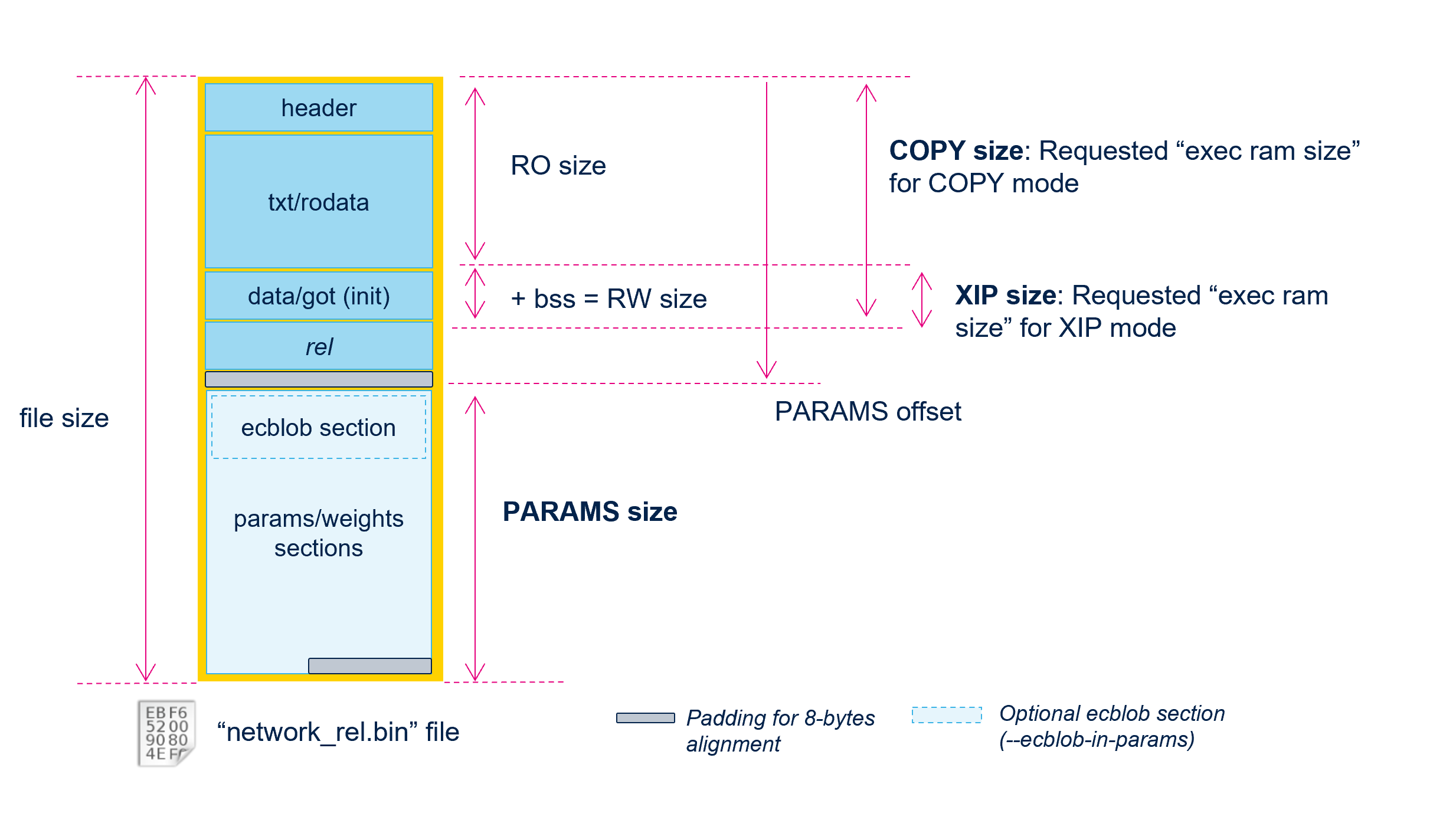
The following figure illustrates the layout of the generated relocatable binary model (
"network_rel.bin"
file). By default,
the memory initializers (params/weights sections) are included in the image. If the
split
option is used,
the params/weights sections are generated in a separated binary file (
"network_rel_params.bin"
file).
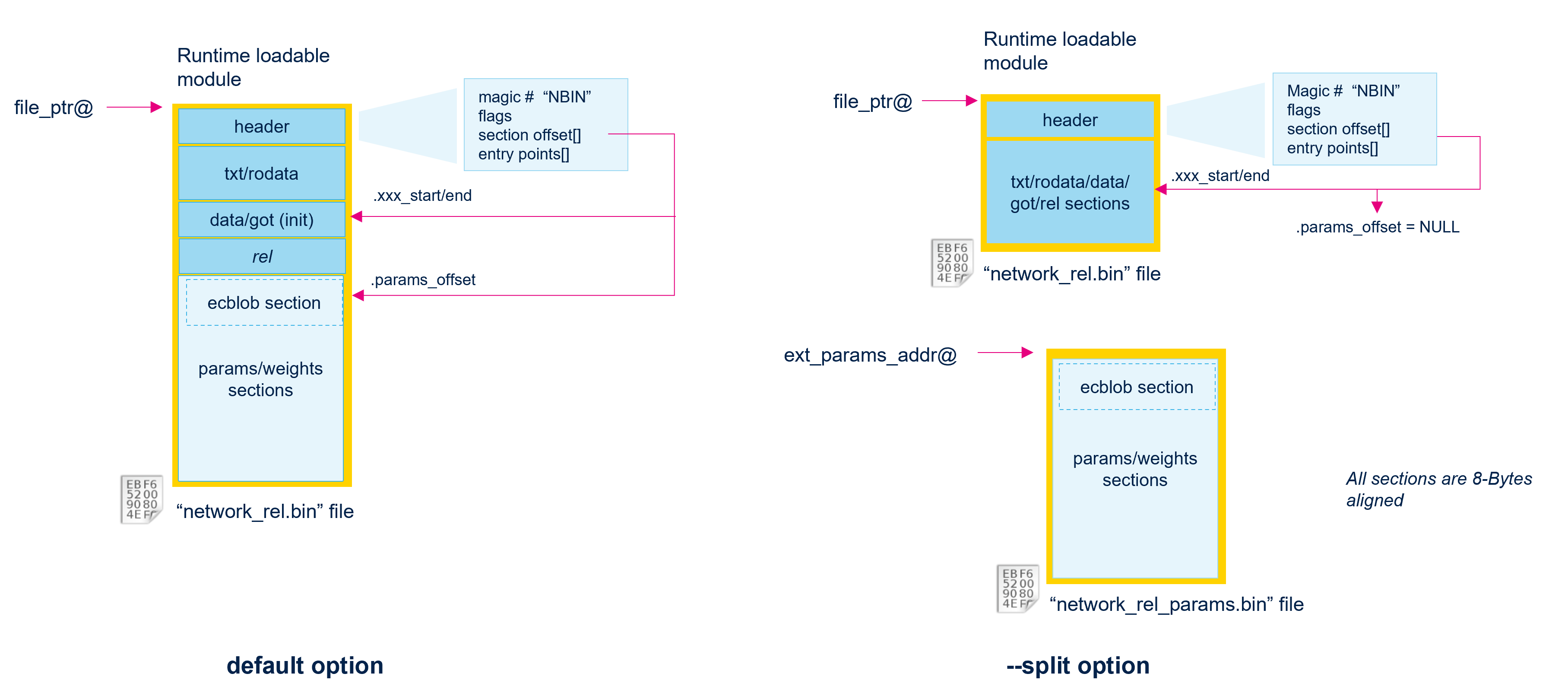
If the epoch controller is enabled, the generated bitstreams are included in the rodata/data sections by defaut. The –ecblob-in-params option can be used to store the ecblob with the params section.
The description of the params/weights sections is defined in the rodata section.
When the split option is used, the address (
'ext_params_add') is passed and defined by the application when the ll_aton_reloc_install() function is called.
Evaluating the RT loadable model (STM32N6570-DK board) 
A ready-to-use environment for STM32N6570-DK board (DEV mode) is delivered in the ST Edge AI Core pack. It allows performing a classical validation workflow, validate command or through the stm_ai_runner Python package module. Note that a STM32CubeIDE environment must be installed.
Warning
Set the boot mode in development mode (BOOT1 switch position is 1-3, BOOT0 switch position does not matter). After the loading phase, the board must be NOT switched off or disconnected to be able to perform the validation.
After the generation of the relocatable binary model, the
st_load_and_run.py
Python script is used to flash the
binary files at the fixed addresses, to load, and to run a built-in validation firmware. After these steps, a single
inference is executed reporting the performance.
[Details] st_load_and_run.py script
usage: st_load_and_run.py [-h] [--input [STR ...]] [--board STR]
                          [--address STR] [--mode STR] [--cube-ide-dir STR]
                          [--log [STR]] [--verbosity [{0,1,2}]] [--debug] [--no-color]

NPU Utility - ST Load and run (dev environment) v2.0

optional arguments:
  -h, --help            show this help message and exit
  --input [STR ...], -i [STR ...]
                        location of the binary files (default: build/network_rel.bin)
  --board STR           ST development board (default: stm32n6570-dk)
  --address STR         destination address - model(,params) (default: 0x71000000,0x71800000)
  --mode STR            firmware variants & mode: copy,xip[no-flash,no-overlay,no-run,usbc,ext]
  --cube-ide-dir STR    installation directory of STM32CubeIDE tools (ex. ~/ST/STM32CubeIDE_1.19.0/STM32CubeIDE)
  --log [STR]           log file
  --verbosity [{0,1,2}], -v [{0,1,2}]
                        set verbosity level
  --debug               enable internal log (DEBUG PURPOSE)
  --no-color            disable log color support
Supported features/limitations 
Only the STM32N6570-DK board is supported. Destination addresses are fixed.
Multiple models can be deployed.
By default, they share the same execution RAM memory region. The
no-overlaymode can be used to force the creation of a dedicated memory region.Execution of the models is always sequential, the activation regions are overlapped.
–no-inputs/outputs-allocation options are not supported.
copyorxipmode can be selected. If thexipmode is not supported,copymode is automatically used.the execution RAM region is located in the internal SRAM first, if more memory is requested, the external RAM is used.
Deploy a model 
$ $STEDGEAI_CORE_DIR/Utilities/windows/python $STEDGEAI_CORE_DIR/Utilities/scripts/N6_reloc/st_load_and_run.py
   -i <output-directory-path>\network_rel.bin
NPU Utility - ST Load and run (dev environment) (version 2.0)
Creating date : ...

model info     : st_ai_output\network_rel.bin: size=55,832
                 cpuid=0xd22 c_name='network' 'Embedded ARM GCC' ll_aton=1.1.3.3
                 acts/params=57,087/22,065 xip/copy=632/13,312 ext_ram=0 split=False
                 secure=True
board          : 'stm32n6570-dk'
mode           : ['copy']

board info     : 'stm32n6570-dk' baudrate=921600 eflash_loader='MX66UW1G45G_STM32N6570-DK.stldr'
                   eflash[sec/pg]=64.0KB/4.0KB
                 exec_ram[int/ext]=655,360/4,194,304 ext_ram=28,311,552 addrs=0x70FFF000,0x71000000,0x71800000
use clang      : False
install mode   : 'copy'
total (1)      : overlay bin=65,536 xip=640 [copy=13,312] 'installed in int exec_ram' ext_ram=0
 flash@        : 0x71000000
 flash_params@ : 0x00000000

Resetting the board.
Flashing 'header (nb_entries=1)' at address 0x70FFF000 (size=20)..
Flashing 'st_ai_output\network_rel.bin' at address 0x71000000 (size=55832)..
Loading & start the validation application 'stm32n6570-dk-validation-reloc'..
Deployed model is started and ready to be used.
Executing the deployed model (desc=serial:921600)..
...
  Inference time per node
  -------------------------------------------------------------------------------------------------------------------
  c_id    m_id   type                dur (ms)       %    cumul  CPU cycles                      name
  -------------------------------------------------------------------------------------------------------------------
  0       -      epoch (EC)             0.210   96.6%    96.6%  [     896  166,877      573 ]   EpochBlock_1 -> 14
  1       -      epoch (SW)             0.007    3.4%   100.0%  [     110       40    5,704 ]   EpochBlock_15
  -------------------------------------------------------------------------------------------------------------------
  total                                 0.218                   [   1,006  166,917    6,277 ]
                                4592.41 inf/s                   [    0.6%    95.8%     3.6% ]
  -------------------------------------------------------------------------------------------------------------------
Evaluate the model 
Default validation workflow can be use to evaluate the deployed model.
$ stedgeai validate -m <quantize_model> --target stm32n6 --mode target -d serial:921600
...
Evaluation report (summary)
 -------------------------------------------------------------------------------------------------------------
 Output       acc    rmse         ...  std        nse        cos        tensor
 -------------------------------------------------------------------------------------------------------------
 X-cross #1   n.a.   0.007084151  ...  0.007081   0.999671   0.999910   10 x uint8(1x3087x6)
 -------------------------------------------------------------------------------------------------------------
Deploy multiple models 
Generate the models:
model1
and
model2
stedgeai generate -m <model1> --target stm32n6 --st-neural-art test@$STEDGEAI_CORE_DIR/Utilities/scripts/N6_reloc/test/neural_art_reloc.json -r -n model1

stedgeai generate -m <model2> --target stm32n6 --st-neural-art test@$STEDGEAI_CORE_DIR/Utilities/scripts/N6_reloc/test/neural_art_reloc.json -r -n model2
Warning
Each deployed model must have its own c-name.
Deploy the models for evaluation
$ $STEDGEAI_CORE_DIR/Utilities/windows/python $STEDGEAI_CORE_DIR/Utilities/scripts/N6_reloc/st_load_and_run.py
   -i <output-directory-path>\model1_rel.bin <output-directory-path>\model2_rel.bin
Evaluate the
model1
model
$ stedgeai validate -m <model12> --target stm32n6 --mode target -d serial:921600 -n model1
Deploy and use a relocatable model 
There is no specific service allowing to deploy the model on a target, FOTA-like mechanism, and other
stack to manage the firmwares or models are application-specific. However, when the relocatable model
is flashed on the target at a given memory-mapped address (
file_ptr),
the
ll_aton_reloc_install()
function must be called to install the model.
LL_ATON stack configuration 
|
LL_ATON_XX C-defines |
comment |
|---|---|
|
LL_ATON_PLATFORM |
|
|
LL_ATON_EB_DBG_INFO |
mandatory |
|
LL_ATON_RT_RELOC |
mandatory - Enables the code paths and functionalities required to manage the relocatable mode. |
|
LL_ATON_RT_MODE |
|
|
LL_ATON_OSAL |
no restriction |
Minimal code 
The following snippet code illustrates how to install and to use a runtime loadable model within a bare metal environment,
single network with a single input tensor, and a single output tensor (epoch controller is used or not).
user_model_mgr()
function is used to retrieve the address where the module has been flashed.
#include "ll_aton_reloc_network.h"

static NN_Instance_TypeDef nn_instance;  /* LL ATON handle */

uint8_t *input_0, *prediction_0;
uint32_t input_size_0, prediction_size_0;

int ai_init(const uintptr_t file_ptr, const uintptr_t file_params_ptr)
{
  const LL_Buffer_InfoTypeDef *ll_buffer;
  ll_aton_reloc_info rt;
  int res;

  /* Retrieve the requested RAM size to install the model */
  res = ll_aton_reloc_get_info(file_ptr, &rt);
  /* Reserve executable memory region to install the model */
  uintptr_t exec_ram_addr = reserve_exec_memory_region(rt.rt_ram_copy);
  /* Reserve external read/write memory region for external RAM region */
  uintptr_t ext_ram_addr = NULL;
  if (rt.ext_ram_sz > 0)
    ext_ram_addr = reserve_ext_memory_region(rt.ext_ram_sz);

  /* Create and install an instance of the relocatable model */
  ll_aton_reloc_config config;
  config.exec_ram_addr = exec_ram_addr;
  config.exec_ram_size = rt.rt_ram_copy;
  config.ext_ram_addr = ext_ram_addr;
  config.ext_ram_size = rt.ext_ram_sz;
  config.ext_param_addr = NULL;  /* or @ of the weights/params if split mode is used */
  config.mode = AI_RELOC_RT_LOAD_MODE_COPY; // | AI_RELOC_RT_LOAD_MODE_CLEAR;

  res = ll_aton_reloc_install(file_ptr, &config, &nn_instance);

  if (res != 0)
  {
    /* Retrieve the addresses of the input/output buffers */
    ll_buffer = ll_aton_reloc_get_input_buffers_info(&nn_instance, 0);
    input_0 = LL_Buffer_addr_start(ll_buffer);
    input_size_0 = LL_Buffer_len(ll_buffer);
    ll_buffer = ll_aton_reloc_get_output_buffers_info(&nn_instance, 0);
    prediction_0 = LL_Buffer_addr_start(ll_buffer);
    prediction_size_0 = LL_Buffer_len(ll_buffer);

    /* Init the LL ATON stack and the instantiated model */
    LL_ATON_RT_RuntimeInit();
    LL_ATON_RT_Init_Network(&nn_instance);
  }
  return res;
}

void ai_deinit(void)
{
  LL_ATON_RT_DeInit_Network(&NN_Instance_Default);
  LL_ATON_RT_RuntimeDeInit();
}

void ai_run(void) {
  LL_ATON_RT_RetValues_t ll_aton_ret;
  LL_ATON_RT_Reset_Network(&nn_instance);
  do {
    ll_aton_ret = LL_ATON_RT_RunEpochBlock(&nn_instance);
    if (ll_aton_ret == LL_ATON_RT_WFE) {
      LL_ATON_OSAL_WFE();
      }
  } while (ll_aton_ret != LL_ATON_RT_DONE);
}

void main(void)
{
  uintptr_t file_ptr, file_params_ptr;

  user_system_init();  /* HAL, clocks, NPU sub-system... */

  user_model_mgr(&file_ptr, &file_params_ptr);
  if (ai_init(file_ptr, file_params_ptr)) {
    /*... installation issue ..*/
  }

  while (user_app_not_finished()) {
    /* Fill input buffers */
    user_fill_inputs(input_0);
    /* If requested, perform the NPU/MCU cache operations to guarantee the coherency of the memory. */
    //  LL_ATON_Cache_MCU_Clean_Invalidate_Range(input_0, input_size_0);
    //  LL_ATON_Cache_MCU_Invalidate_Range(prediction_0, prediction_size_0);
    /* Perform a complete inference */
    ai_run();
    /* Post-process the predictions */
    user_post_process(prediction_0);
  }
  ai_deinit();
  //...
}
XIP/COPY execution modes 
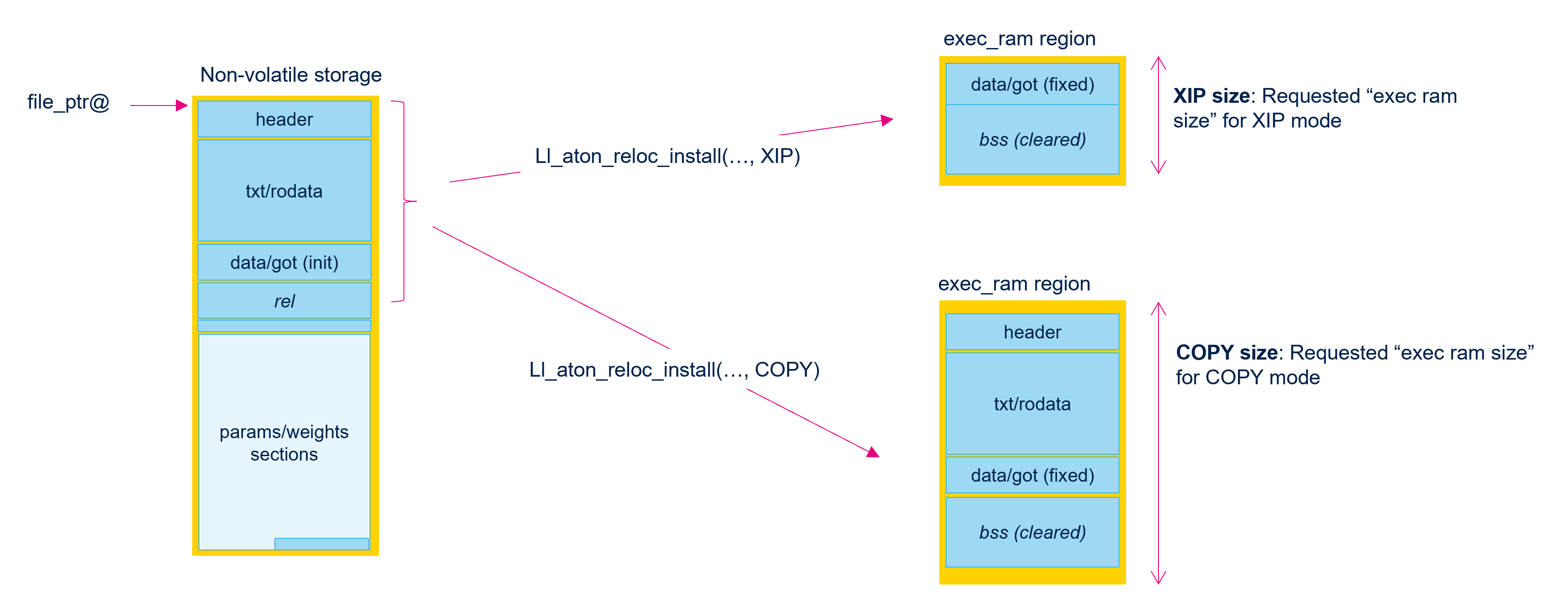
XIP execution mode 
This execution mode is the privileged mode, where the code and weight sections are stored in the flash memory. Regarding memory placement, this approach is similar to the static method. This mode is efficient in terms of memory usage, only the executable RAM region to store the data/bss/got sections is requested.
COPY execution mode 
This mode involves copying the code to a different memory location before execution. This process is useful for optimizing performance or managing memory access speeds. The requested size for the executable RAM region is critical. Along with the data, bss, and GOT sections, it also includes the text and rodata sections.
Example of NPU compiler configuration files 
Memory-pool descriptor files 
The
"%STEDGEAI_CORE_DIR%/scripts/N6_reloc/test"
contains a set of configuration and
memory-pool
descriptor files which can be
used. Here are two main points to consider:
If nonsecure context is used to execute the deployed model, the base @ of the different memory-pools should be set with a nonsecure address (ex.
0x24350000instead of0x34350000for the AXIRAM6 memory).For the memory-pools representing an off-chip device, the
"USEMODE_RELATIVE"attribute should be used.
For test purpose with STM32N6570-DK board, different ready-to-use configurations are provided.
|
memory-pool desc. file |
description |
|---|---|
|
stm32n6_reloc.mpool |
Full memories. All NPU rams (AXIRAM3..6), AXIRAM2 and external RAM/flash are defined. NPU cache can be used for the external memories. |
|
stm32n6_npuram.mpool |
NPU memories only. Only the NPU rams (AXIRAM3..6) are defined. |
|
stm32n6_int.mpool |
Internal memories only. Only the NPU RAMs (AXIRAM3..6 and AXIRAM2) are defined. |
|
stm32n6_int2.mpool |
Internal memories only. Similar to stm32n6_int.mpool but the AXIRAM2 is privileged for the weights. |
|
stm32n6_reloc_ext.mpool |
External memories only. Only the external RAM/flash are defined. NPU cache can be used for the external memories. |
For information and test purpose, the “non” reloc memory-pool descriptor files are provided which can be used with a normal deployment flow.
Part of the ``./test/mpool/stm32n6_reloc.mpool`` file:
...
{
    "fname": "AXISRAM6",
    "name":  "npuRAM6",
    "fformat": "FORMAT_RAW",
    "prop":   { "rights": "ACC_WRITE", "throughput": "HIGH", "latency": "LOW",
                "byteWidth": 8, "freqRatio": 1.25, "read_power": 18.531, "write_power": 16.201 },
    "offset": { "value": "0x34350000", "magnitude":  "BYTES" },
    "size":   { "value": "448",        "magnitude": "KBYTES" }
},
{
    "fname": "xSPI1",
    "name":  "hyperRAM",
    "fformat": "FORMAT_RAW",
    "prop":   { "rights": "ACC_WRITE", "throughput": "MID", "latency": "HIGH",
                "byteWidth": 2, "freqRatio": 5.00, "cacheable": "CACHEABLE_ON",
                "read_power": 380, "write_power": 340.0, "constants_preferred": "true" },
    "offset": { "value": "0x90000000", "magnitude":  "BYTES" },
    "size":   { "value": "32",         "magnitude": "MBYTES" },
    "mode":   "USEMODE_RELATIVE"
},
{
    "fname": "xSPI2",
    "name":  "octoFlash",
    "fformat": "FORMAT_RAW",
    "prop":   { "rights": "ACC_READ",  "throughput": "MID", "latency": "HIGH",
                "byteWidth": 1, "freqRatio": 6.00, "cacheable": "CACHEABLE_ON",
                "read_power": 110, "write_power": 400.0, "constants_preferred": "true" },
    "offset": { "value": "0x70400000", "magnitude":  "BYTES" },
    "size":   { "value": "64",         "magnitude": "MBYTES" },
    "mode":   "USEMODE_RELATIVE"
}
...
“neural_art.json” file 
The
"%STEDGEAI_CORE_DIR%/scripts/N6_reloc/test"
contains two examples of configuration file using the
requested memory-pool descriptor files. They provide different profiles using different memory configurations
which are aligned with the generic AI test validation.
|
profile |
description |
|---|---|
|
test |
Default profile. Full memories configuration and the epoch controller are not enabled |
|
test-ec |
Default profile + support of the epoch controller |
|
test-int |
Internal profile. NPU memories only configuration and the epoch controller is not enabled |
|
test-int-ec |
Internal profile + support of the epoch controller |
|
test-ext |
External profile. NPU memories only configuration and the epoch controller is not enabled |
|
test-ext-ec |
External profile + support of the epoch controller |
Part of the ``./test/neural_art_reloc.json`` file:
...
 "test" : {
  "memory_pool": "./mpools/stm32n6_reloc.mpool",
    "options": "--native-float --cache-maintenance --Ocache-opt --enable-virtual-mem-pools --Os
                  --optimization 3 --Oauto-sched --all-buffers-info --csv-file network.csv"
 },
 "test-ec" : {
  "memory_pool": "./mpools/stm32n6_reloc.mpool",
      "options": "--native-float --cache-maintenance --Ocache-opt --enable-virtual-mem-pools --Os
                  --optimization 3 --Oauto-sched --all-buffers-info --csv-file network.csv --enable-epoch-controller"
 },
...
Performance impacts 
Accuracy 
No difference with the nonrelocatable or static implementation.
Set up and inference time 
For the inference time (after the install/init steps), no significant difference is expected versus a nonrelocatable or static implementation. Only the set-up time is impacted to install/create an instance of a given model. The installation time is directly proportional to the number of relocations, and the size of the code/data sections according to the used COPY/XIP mode. Note that if the memory initializers need to be copied into the internal RAMs, this extra time is equivalent to the static implementation.
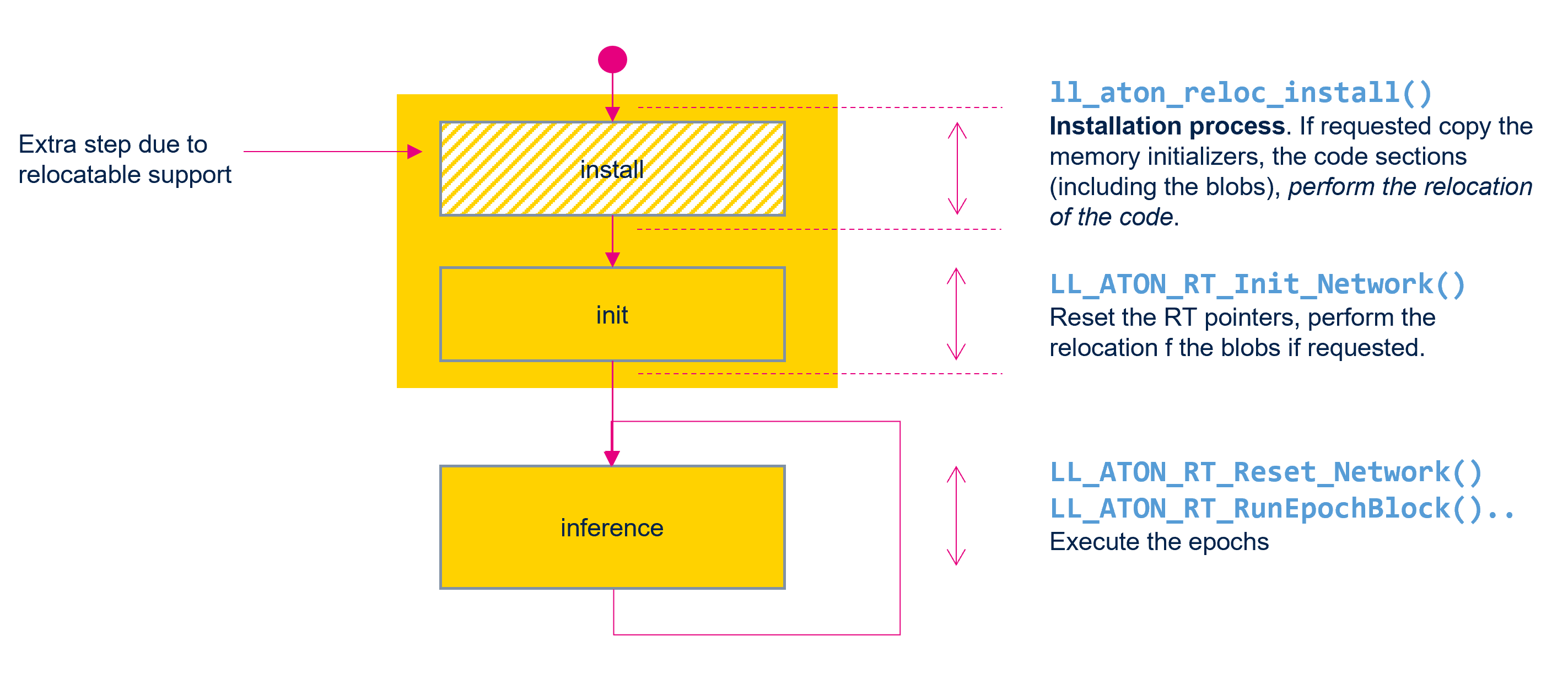
STM32N6570-DK board (DEV mode), overdrive clock setting (NPU 1 GHz, MCU 800 MHz).
By default, the external flash is used to store the weights/params.
Internal RAMs (AXIRAM3,..6) are used to store the activations.
The executable RAM region is located in the internal AXIRAM1 (this is equivalent to the static case where the application is also executed from the AXIRAM1).
|
yolov5 224 (nano) |
static mode (absolute @ only) |
reloc mode (copy) |
reloc mode (xip) (*) |
|---|---|---|---|
|
inference time (w/ ec) |
10.4 ms, 95.45 inf/s |
10.5 ms, 94.9 inf/s |
10.6 ms, 94.6 inf/s |
|
inference time (w/o ec) |
13.2 ms, 75.35 inf/s |
13.0 ms, 77.1 inf/s |
14.3 ms, 69.6 inf/s |
|
install/init time (ms) (w/ ec) |
0.0 / 0.03 |
11.7 / 0.73 |
10.9 / 0.93 |
|
install/init time (ms) (w/o ec) |
0.0 / 0.03 |
11.2 / 0.03 |
10.8 / 0.03 |
(*) with the epoch controller, as the blob should be updated, it is fetched from the executable RAM region (AXIRAM1). We only observe an impact in the case where the configuration code is fetched from the external FLASH, w/o epoch controller support.
For the reloc mode with epoch controller support, the
'install/init'
time is mainly due to the copy of the blobs
in the AXIRAM1 and the requested relocations to resolve the weights/params addresses in the different blobs.
Case where only the AXIRAMx is used for the activations and the weights/params (~2 Mbytes)
|
yolov5 224 (nano) |
static mode (absolute @ only) |
reloc mode (copy) |
reloc mode (xip) |
|---|---|---|---|
|
inference time (w/ ec) |
9.5 ms, 105.3 inf/s |
9.5 ms, 105.8 inf/s |
9.6 ms, 104.6 inf/s |
|
install/init time (ms) (w/ ec) |
17+ / 0.03 |
18.1 / 0.03 |
18.1 / 0.03 |
The
'install/init'
time is similar in both case. It is mainly represented by the copy of the
memory initializers from the FLASH location to the internal RAMs. No extra relocation for the
weights/activations is requested (all weighs/activations addresses are absolutes).
Memory layout overhead 
In comparison with a static implementation, the relocation mode involves two additional sections, GOT/REL, which are used to support the position-independent code/data. The size is directly proportional to the number of relocating references.
LL ATON runtime API extension 
To enable the support of a runtime loadable model, the LL_ATON files should be compiled with the following C-define:
LL_ATON_RT_RELOC
The
LL_ATON_RT_RELOC
C-define activates the code paths and functionalities required to manage and install runtime
loadable models. Ensuring that this macro is defined during compilation is crucial for the successful deployment and
execution of runtime loadable models.
ll_aton_reloc_install() 
int ll_aton_reloc_install(const uintptr_t file_ptr, const ll_aton_reloc_config *config,
                          NN_Instance_TypeDef *nn_instance);
Description 
The
ll_aton_reloc_install()
function acts as a runtime dynamic loader. It is used to install and to create an instance of a
memory-mapped runtime loadable module. By providing the model image pointer (
file_ptr),
configuration details, and neural network instance, users can set up the model for execution. The function performs
compatibility checks, initializes memory pools, and installs/relocates code and data sections as needed.
Parameters 
file_ptr: Auintptr_tvalue representing the pointer to the image of the runtime loadable model. This parameter specifies the location of the model image to be installed.config: A pointer to an ll_aton_reloc_config structure. This parameter provides the configuration details for how the model should be installed, including memory addresses and sizes.nn_instance: A pointer to anNN_Instance_TypeDefstructure. This parameter is updated to handle the installed model, creating an instance of the neural network.
Return Value 
The function returns an integer value. A return value of
0typically indicates success, while a nonzero value indicates that an error occurred during the installation process.
Steps Executed 
Checking step
This step checks the compatibility of the binary object against the runtime environment (static part of the firmware). The main points checked include:
The version and content of the binary file header.
MCU type and whether the FPU (floating-point unit) is enabled (context/setting of the caller is used).
Secure or nonsecure context.
Whether the binary module has been compiled with the
LL_ATON_EB_DBG_INFOorLL_ATON_RT_ASYNCC-defines.Version of the used LL_ATON files.
Memory-Pool initialization step
If requested, this step initializes the used memory regions for the given model. Specifically:
If read/write memory pools handle the params/weights section, the associated memory region is initialized with values from the params/weights section.
Optionally, if the
AI_RELOC_RT_LOAD_MODE_CLEARflag is set, the read/write memory region handling the activations is cleared.
Code/Data installation and relocation step
According to the
AI_RELOC_RT_LOAD_MODE_COPYorAI_RELOC_RT_LOAD_MODE_XIPflag:The code/data sections are copied into the executable RAM region.
The relocation process is performed to update references.
Register the call-backs
This function installs and creates an instance of a runtime loadable model referenced by
the
file_ptr
parameter. The
config
parameter (of type
ll_aton_reloc_config)
indicates how to install the model, and the
nn_instance
(of type
NN_Instance_TypeDef) is updated to handle the
installed model. This function executes the following steps:
ll_aton_reloc_config C-struct 
The purpose of the
ll_aton_reloc_config
C structure is to provide the parameters which are requested to install a runtime
loadable model.
typedef struct _ll_aton_reloc_config {
    uintptr_t exec_ram_addr;  /* base@ of the exec memory region to place the relocatable code/data (8-Bytes aligned) */
    uint32_t exec_ram_size;   /* max size in byte of the exec memory region */
    uintptr_t ext_ram_addr;   /* base@ of the external memory region to place the external pool (if requested) */
    size_t ext_ram_size;      /* max size in byte of the external memory region */
    uintptr_t ext_param_addr; /* base@ of the param memory region (if requested) */
    uint32_t mode;
  } ll_aton_reloc_config;
'exec_ram_addr'/'exec_ram_size': These members indicate the base address (8-byte aligned) and the maximum size of the read/write executable RAM memory region. These parameters are mandatory. To determine the required size at runtime, the ll_aton_reloc_get_info function can be used.'ext_ram_addr'/'ext_ram_addr': These members indicate the base address (8-byte aligned) and the maximum size of the read/write external RAM memory region, if requested. To determine the required size at runtime, the ll_aton_reloc_get_info function can be used.'ext_param_addr': This member indicates the base address (8-byte aligned) of the memory region containing the parameters/weights of the deployed model. This option is required when the split option is used; otherwise, it must be set to NULL.'mode': This member indicates the expected execution mode. Or-ed flags can be used.AI_RELOC_RT_LOAD_MODE_XIPorAI_RELOC_RT_LOAD_MODE_CLEARflag is mandatory.AI_RELOC_RT_LOAD_MODE_CLEARflag is optional.
|
mode |
description |
|---|---|
|
|
|
|
|
|
|
|
Reset the used activation memory regions |
ll_aton_reloc_set_callbacks() 
int ll_aton_reloc_set_callbacks(const NN_Instance_TypeDef *nn_instance, const struct ll_aton_reloc_callback *cbs)
Description 
The
ll_aton_reloc_set_callbacks
function is used to overwrite the default registration of the callbacks done in the
ll_aton_reloc_install
function.
This function is optional.
|
Callback services |
description |
|---|---|
|
assert/lib error |
to implement the management of the errors generated by the embedded LL ATON functions |
|
NPU/MCU cache maintenance operations |
to implement the NPU/MCU cache maintenance operations |
|
LL_ATON_LIB_xxx |
to implement the LL ATON LIB services to support the hybrid epochs |
Parameters 
nn_instance: A pointer to the neural network instance (NN_Instance_TypeDef).cbs: A pointer to all_aton_reloc_callbackstructure (seell_aton_reloc_network.hfile).
Return Value 
The function returns an integer value. A return value of
0typically indicates success, while a nonzero value indicates that an error occurred during the installation process.
ll_aton_reloc_get_info() 
int ll_aton_reloc_get_info(const uintptr_t file_ptr, ll_aton_reloc_info *rt);
Description 
The
ll_aton_reloc_get_info
function is used to obtain the main dimensioning information from the image of a runtime loadable model.
This information can include details such as the size, memory requirements, and other relevant attributes of the model. By providing
a pointer to the model image and a reference to an
ll_aton_reloc_info
structure, users can retrieve and store the necessary
information to properly configure and manage the runtime loadable model.
This function is particularly useful for setting up the memory regions and ensuring that the model can be correctly loaded and executed within the available resources.
Parameters 
file_ptr: Auintptr_tvalue representing the pointer to the image of the runtime loadable model. This parameter specifies the location of the model image from which the information will be retrieved.rt: A pointer to an ll_aton_reloc_info structure. This parameter is used to store the retrieved dimensioning information of the runtime loadable model. The function fills this structure with the relevant details.
Return Value 
The function returns an integer value. A return value of
0typically indicates success, while a nonzero value indicates that an error occurred during the operation.
ll_aton_reloc_info C-struct 
typedef struct _ll_aton_reloc_info
{
  const char *c_name;          /* c-name of the model */
  uint32_t variant;            /* 32-b word to handle the reloc rt version,
                                  the used ARM Embedded compiler,
                                  Cortex-Mx (CPUID) and if the FPU is requested */
  uint32_t code_sz;            /* size of the code (header + txt + rodata + data + got + rel sections) */
  uint32_t params_sz;          /* size (in bytes) of the weights */
  uint32_t acts_sz;            /* minimum requested RAM size (in bytes) for the activations buffer */
  uint32_t ext_ram_sz;         /* requested external ram size for the activations (and params) */
  uint32_t rt_ram_xip;         /* minimum requested RAM size to install it, XIP mode */
  uint32_t rt_ram_copy;        /* minimum requested RAM size to install it, COPY mode */
  const char *rt_version_desc; /* rt description */
  uint32_t rt_version;         /* rt version */
  uint32_t rt_version_extra;   /* rt version extra */
} ll_aton_reloc_info;
|
member |
description |
|---|---|
|
|
indicates the name of the model. |
|
|
or-red 32-bit value indicating the used Arm compiler, CPUID of the Cortex®-M,.. (see
|
|
|
size in bytes of all code/data sections representing the model: header+txt+rodata+data+got+rel sections |
|
|
total size (in bytes) of the params/weights section |
|
|
total size (in bytes) of the activations |
|
|
requested size (in bytes) of the external RAM memory |
|
|
requested size (in bytes) of read/write execution memory region (XIP mode) |
|
|
requested size (in bytes) of read/write execution memory region (COPY mode) |
|
|
(debug info) string describing the used LL runtime version |
|
|
LL runtime version:
|
|
|
(debug info) extra dev version value |
ll_aton_reloc_get_mem_pool_desc() 
ll_aton_reloc_mem_pool_desc *ll_aton_reloc_get_mem_pool_desc(const uintptr_t file_ptr, int index);
Description 
The
ll_aton_reloc_get_mem_pool_desc
function allows to obtain information about the part of the memory-pools which are used for
a given model. By providing a pointer to the model image and an index, users can retrieve the necessary information through
the returned
ll_aton_reloc_mem_pool_desc
structure.
The
ll_aton_reloc_get_mem_pool_desc
function allows users to obtain information about parts of the memory pools used for a given model.
By providing a pointer to the model image and an index, users can retrieve the necessary information through the returned
ll_aton_reloc_mem_pool_desc
structure.
Parameters 
file_ptr: Auintptr_tvalue representing the pointer to the image of the runtime loadable model. This parameter specifies the location of the model image from which the information will be retrieved.index: Index of the requested descriptor.
Return Value 
The function returns a reference of a
ll_aton_reloc_mem_pool_descobject. If the specified index is out of range, the function may return NULL.
Example 
A typical snippet of code to display memory pool C-descriptors.
ll_aton_reloc_mem_pool_desc *mem_c_desc;
int index = 0;

while ((mem_c_desc = ll_aton_reloc_get_mem_pool_desc((uintptr_t)bin, index)))
{
  printf(" %d: flags=%x foff=%d dst=%x s=%d\n", index, mem_c_desc->flags,
         mem_c_desc->foff, mem_c_desc->dst, mem_c_desc->size);
  index++;
}
ll_aton_reloc_mem_pool_desc C-struct 
typedef struct _ll_aton_reloc_mem_pool_desc
{
  const char *name; /* name */
  uint32_t flags;   /* type definition: 32b:4x8b <type><data_type><reserved><id> */
  uint32_t foff;    /* offset in the binary file */
  uint32_t dst;     /* dst @ */
  uint32_t size;    /* real size */
} ll_aton_reloc_mem_pool_desc;
AI_RELOC_MPOOL_GET_XXX(flags)
macros (see
ll_aton_reloc_network.h
file) can be used to know the
attributes of the memory pool.
ll_aton_reloc_get_input/output_buffers_info() 
const LL_Buffer_InfoTypeDef *ll_aton_reloc_get_input_buffers_info(const NN_Instance_TypeDef *nn_instance,
                                                                  int32_t num);
const LL_Buffer_InfoTypeDef *ll_aton_reloc_get_output_buffers_info(const NN_Instance_TypeDef *nn_instance,
                                                                   int32_t num);
Description 
The
ll_aton_reloc_get_input/output_buffers_info
function is used to obtain information about a specific input/output buffer of
a neural network instance. This can be useful for understanding the structure and requirements of the input data for the neural
network. By providing the neural network instance and the index of the desired input buffer, users can retrieve detailed information
about the buffer, such as its size, type, and memory location.
Parameters 
nn_instance: A pointer to the neural network instance (NN_Instance_TypeDef). This parameter specifies the neural network instance for which the input/output buffer information is to be retrieved.num: An integer specifying the index of the input/output buffer whose description is to be retrieved. The index is zero-based, meaning thatnum = 0refers to the first input buffer,num = 1refers to the second input buffer, and so on.
Return Value 
The function returns a pointer to a
LL_Buffer_InfoTypeDefstructure, which contains the description of the specified input/output buffer. If the specified buffer index is out of range, the function may return NULL.
ll_aton_reloc_set_input/output() 
LL_ATON_User_IO_Result_t ll_aton_reloc_set_input(const NN_Instance_TypeDef *nn_instance, uint32_t num, void *buffer,
                                                 uint32_t size);
LL_ATON_User_IO_Result_t ll_aton_reloc_set_output(const NN_Instance_TypeDef *nn_instance, uint32_t num, void *buffer,
                                                  uint32_t size);
Description 
Both
ll_aton_reloc_set_input
and
ll_aton_reloc_set_output
functions are used to configure the address of the input
and output buffers for a neural network instance, respectively. By providing the neural network instance, buffer index,
buffer pointer, and buffer size, users can set up the necessary memory regions for input and output data.
Warning
These functions should be only used when the deployed model is generated with the ‘–no-inputs-allocation’ or/and ‘–no-outputs-allocation’ respectively.
Parameters 
nn_instance: A pointer to the neural network instance (NN_Instance_TypeDef). This parameter specifies the neural network instance for which the output buffer is to be set.num: An unsigned integer specifying the index of the output buffer to be set. The index is zero-based.buffer: A pointer to the buffer that will hold the output data. This parameter specifies the memory location where the output data is stored.size: An unsigned integer specifying the size of the input/output buffer in bytes.
Return Value 
The function returns a value of type
LL_ATON_User_IO_Result_t. This return value indicates the result of the operation, such as success or an error code.
ll_aton_reloc_get_input/output() 
void *ll_aton_reloc_get_input(const NN_Instance_TypeDef *nn_instance, uint32_t num);
void *ll_aton_reloc_get_output(const NN_Instance_TypeDef *nn_instance, uint32_t num);
Description 
Both
ll_aton_reloc_get_input
and
ll_aton_reloc_get_output
functions are used to retrieve pointers to the input and output buffers
for a neural network instance, respectively. By providing the neural network instance and buffer index, users can obtain direct
access to the memory regions used for input and output data.
Warning
These functions should be only used when the deployed model is generated with the ‘–no-inputs-allocation’ or/and ‘–no-outputs-allocation’ respectively.
Parameters 
nn_instance: A pointer to the neural network instance (NN_Instance_TypeDef). This parameter specifies the neural network instance for which the input/output buffer pointer is to be retrieved.num: An unsigned integer specifying the index of the output buffer to be retrieved. The index is zero-based.
Return Value 
The function returns a pointer to the output buffer. If the specified buffer index is out of range or an error occurs, the function may return
NULL.
Use directly the Python scripts 
Generating the relocatable binary model 
The
npu_driver.py
is the entry point for executing the steps required to generate the loadable model. The
'--input/-i'
is used
to specify the location of the generated
"network.c"
and associated memory initializers (
*.raw


             files
). The default value
is
./st_ai_output. The
'--output\-o'
option is used to specify the output folder (default:
./build).
[Details] npu_driver.py script
usage: npu_driver.py [-h] [--input STR] [--output STR] [--name STR] [--no-secure] [--no-dbg-info] [--ecblob-in-params]
                     [--split] [--llvm] [--st-clang] [--compatible-mode] [--custom [STR]] [--cross-compile STR]
                     [--gen-c-file] [--parse-only] [--no-clean] [--log [STR]] [--json [STR]] [--verbosity [{0,1,2}]]
                     [--debug] [--no-color]

NPU Utility - Relocatable model generator v1.4

optional arguments:
  -h, --help            show this help message and exit
  --input STR, -i STR   location of the generated c-files (or network.c file path)
  --output STR, -o STR  output directory
  --name STR, -n STR    basename of the generated c-files (default=<network-file-name>)
  --no-secure           generate binary model for non secure context
  --no-dbg-info         generate binary model without LL_ATON_EB_DBG_INFO
  --ecblob-in-params    place the EC blob in param section
  --split               generate a separate binary file for the params/weights
  --llvm                use LLVM compiler and libraries (default: GCC compiler is used)
  --st-clang            use ST CLANG compiler and libraries (default: GCC compiler is used)
  --compatible-mode     set the compible option (target dependent)
  --custom [STR]        config file for custom build (default: custom.json)
  --cross-compile STR   prefix of the ARM tool-chain (CROSS_COMPILE env variable can be used)
  --gen-c-file          generate c-file image (DEBUG PURPOSE)
  --parse-only          parsing only the generated c-files
  --no-clean            Don't clean the intermediate files
  --log [STR]           log file
  --json [STR]          Generate result file (json format)
  --verbosity [{0,1,2}], -v [{0,1,2}]
                        set verbosity level
  --debug               Enable internal log (DEBUG PURPOSE)
  --no-color            Disable log color support
“–name/-n” option 
The
--name/-n
option allows to specify/overwrite the expected c-name/file-name of the loadable runtime model.
By default, the name of the generated network files is used.
Default behavior.
$ python npu_driver.py -i <gen-dir>/network.c
...
Generating files...
    creating "build\network_rel.bin" (size=..)
$ python npu_driver.py -i <gen-dir>/my_model.c
...
Generating files...
    creating "build\network_rel.bin" (size=..)
$ python npu_driver.py -i <gen-dir>/network.c -n toto
...
Generating files...
    creating "build\toto_rel.bin" (size=..)