
 HAL2 Migrator

Script stubbing features 
Overview 
In addition to its detection capabilities, the HAL1 detection script provides a robust stubbing mechanism for HAL1 elements within user code. The stubbing feature supports a wide range of constructs, including:
Function calls (direct, nested, or conditional)
Structures (such as typedefs, function arguments, or initializations)
Enumerations (user-defined or used within function calls)
Constants (as arguments or in variable assignments)
Macros
The following sections provide a comprehensive overview of stubbing configuration, supported patterns, and corresponding resolution techniques.
Note
Stubbing refers to the isolation and exclusion of code segments related to the HAL1 API, such as function calls, variable declarations, and other associated components.
|
Original code |
Stubbed code |
|---|---|
HAL_ADC_Start();
|
#ifdef TO_DO_RESOLVE_STUB
HAL_ADC_Start();
#endif /* TO_DO_RESOLVE_STUB */
|
Stubbing and warning message configuration 
Stubbing configuration 
Users can customize the stubbing compilation flag to meet their specific requirements. This customization can be performed by overriding the default value of
StubbingCompilationFlag
in the
hal1_detection_config.py
file or by modifying it through the interactive menu.
|
Field |
Default value |
Description |
|---|---|---|
|
StubbingCompilationFlag |
TO_DO_RESOLVE_STUB |
Flag used for HAL1 stubbing. |
Warning message configuration 
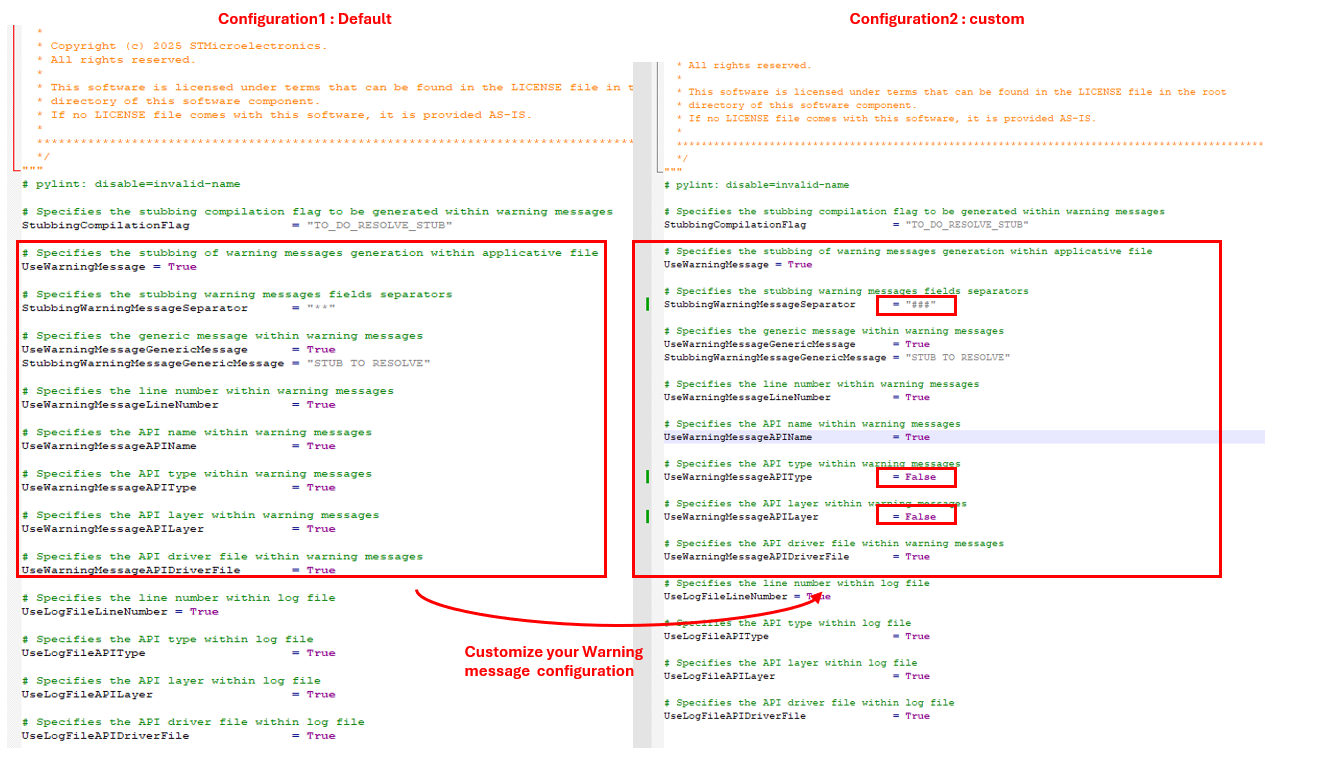
Users can customize the injected warning log messages based on their preferences. To do this, modify the
hal1_detection_config.py
file.
Note
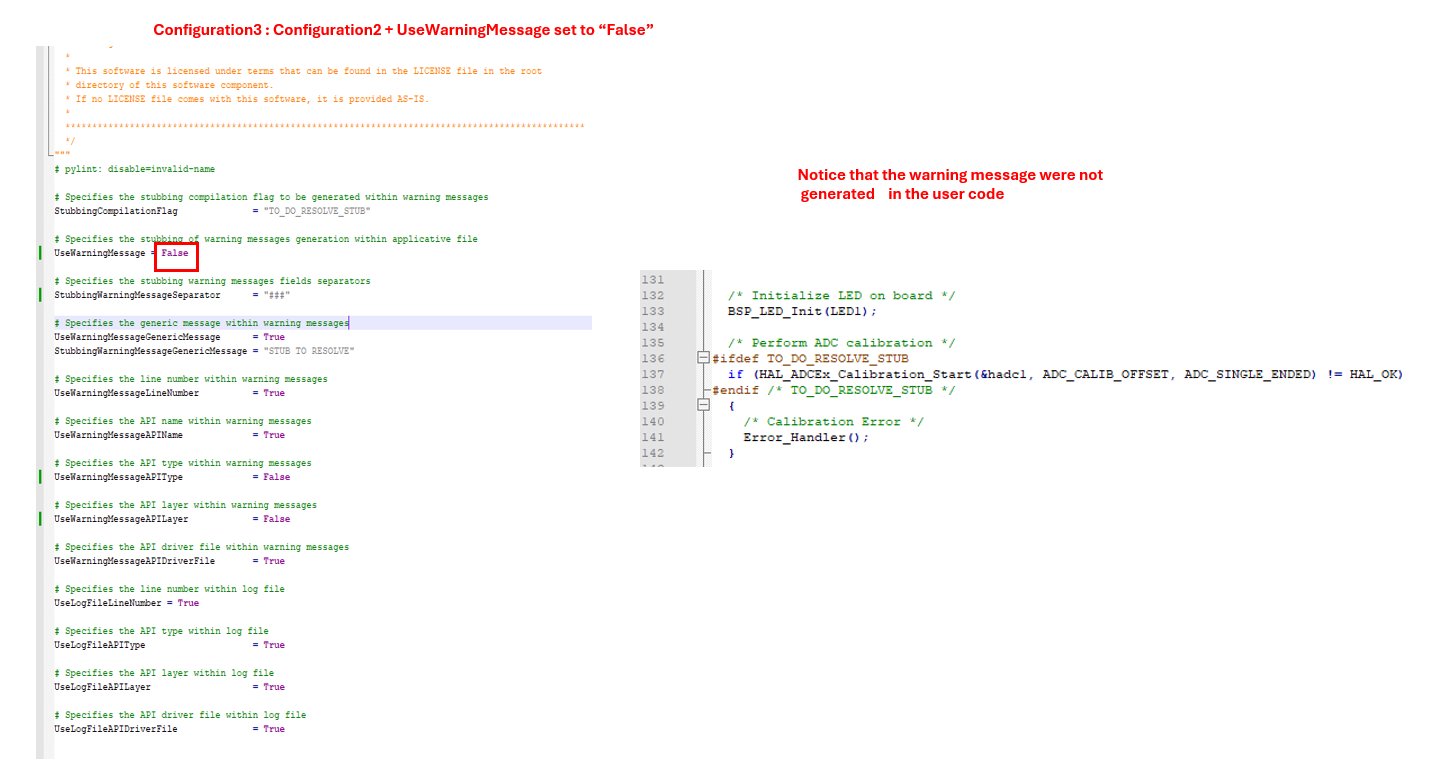
The
UseWarningMessage
field must be set to
True
to enable the customization of the configuration; otherwise, the customized settings are ignored.
|
Field |
Default value |
Possible configuration |
|---|---|---|
|
UseWarningMessage |
True |
True/False |
The available field configurations are listed in the table below.
|
Field |
Default value |
Possible configuration |
|---|---|---|
|
StubbingWarningMessageSeparator |
|
The user can override with their own defined separator |
|
StubbingWarningMessageGenericMessage |
STUB TO RESOLVE |
The user can override with their own message |
|
UseWarningMessageGenericMessage |
True |
True/False |
|
UseWarningMessageLineNumber |
True |
True/False |
|
UseWarningMessageAPIName |
True |
True/False |
|
UseWarningMessageAPIType |
True |
True/False |
|
UseWarningMessageAPILayer |
True |
True/False |
|
UseWarningMessageAPIDriverFile |
True |
True/False |
Examples 
|
Example |
|---|
|
Edit the
|
|
Configuration 1 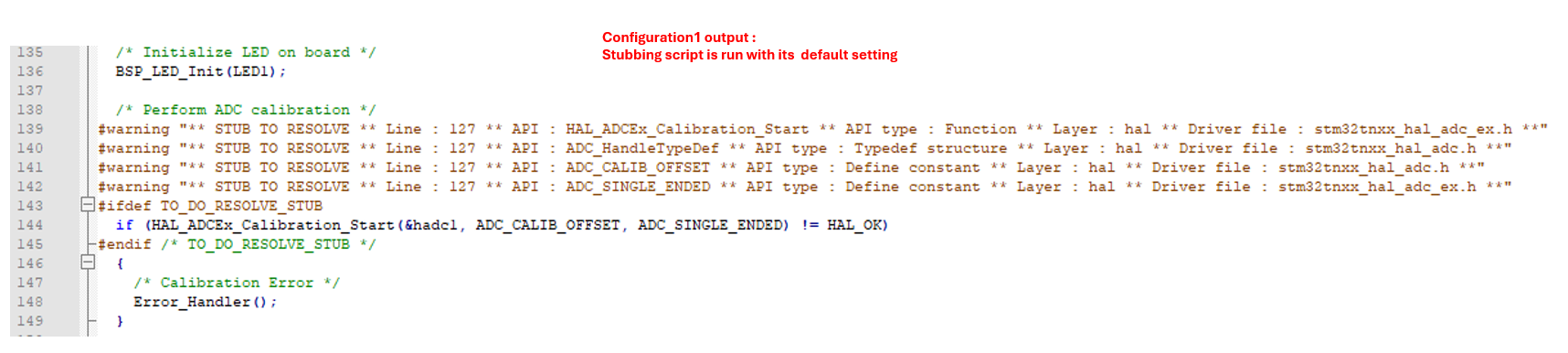
|
|
Configuration 2 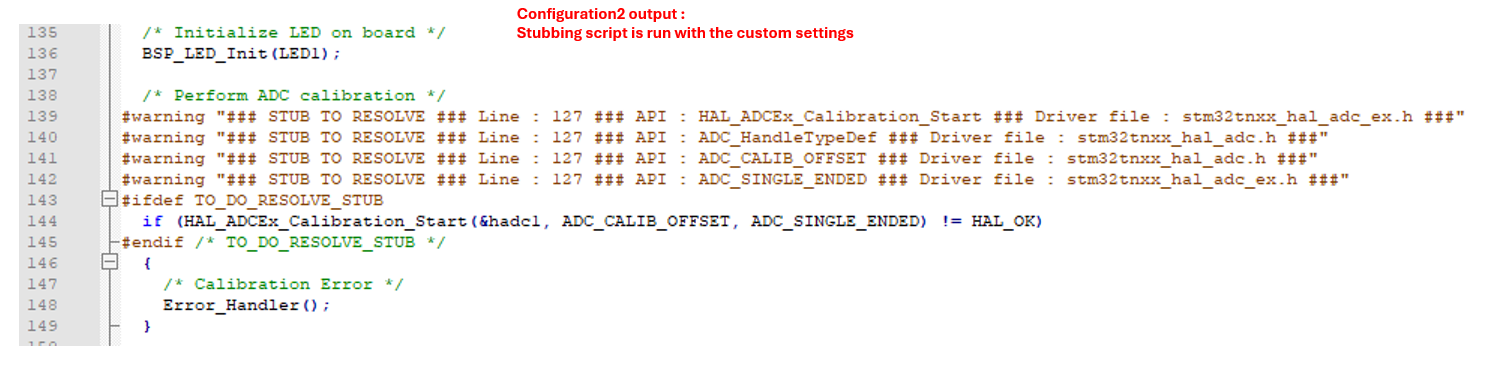
|
|
Configuration 3 (edit of configuration 2 by setting the
|
Using the stubbing feature 
Detection and stubbing 
|
Item |
Description |
|---|---|
|
Purpose |
Analyze the source files and modify them by stubbing the selected modules. A detailed log file is generated. |
|
Syntax |
Use one of the following commands: # Using the Python script
# Compatible with bash and Windows console
python hal1_detection.py -d stub -psrc PATH -m all|module1 module2 ...
# Using the executable on bash
./hal1_detection.exe -d stub -psrc PATH -m all|module1 module2 ...
# Using the executable on Windows console
hal1_detection.exe -d stub -psrc PATH -m all|module1 module2 ...
|
|
Mandatory arguments |
|
Examples 
|
Examples |
|---|
# On windows console
# Detect and stub all HAL1 APIs in .\src
hal1_detection.exe -d stub  -psrc .\src -m all

# On bash env use
./hal1_detection.exe -d stub  -psrc ./src -m all
|
# On windows console
# Detect and stub only 'gpio' and 'uart' APIs in .\src
hal1_detection.exe -d stub -psrc .\src -m gpio uart

# On bash env use
./hal1_detection.exe -d stub -psrc ./src -m gpio uart
|
# On windows console
# Detect and stub specific HAL1 APIs in a single file
hal1_detection.exe -d stub -psrc .\src\main.c -m spi i2c

# On bash env use
./hal1_detection.exe -d stub -psrc ./src/main.c -m spi i2c
|
HAL1 API detection and stubbing feature 
Stubbing patterns 
Function and macro stubbing patterns 
The script isolates every detected HAL1 function and macro using the stubbing flag.
The table below outlines the function and macro stubbing patterns implemented in the script.
|
General pattern |
Example |
|---|---|
HAL_PPP_Function(&hppp, param1, ...);
|
#ifdef TO_DO_RESOLVE_STUB
  HAL_PPP_Function(&hppp, param1, ...);
#endif /* TO_DO_RESOLVE_STUB */
|
if (HAL_PPP_Function(&hppp, param1,...) == Condition)
{
    HAL_PPP_Function2(&hppp, param1,...);
}
|
#ifdef TO_DO_RESOLVE_STUB
  if (HAL_PPP_Function(&hppp, param1,...) == Condition)
#endif /* TO_DO_RESOLVE_STUB */
{
#ifdef TO_DO_RESOLVE_STUB
  HAL_PPP_Function2(&hppp, param1,...);
#endif /* TO_DO_RESOLVE_STUB */
}
|
if (HAL_PPP_Function(&hppp, param1,...) == Condition)
{
    HAL_PPP_Function(&hppp, param1,...);
}
else
{
    HAL_PPP_OtherFunction(&hppp, param1,...);
}
|
#ifdef TO_DO_RESOLVE_STUB
if (HAL_PPP_Function(&hppp, param1,...) == Condition)
#endif /* TO_DO_RESOLVE_STUB */
{
#ifdef TO_DO_RESOLVE_STUB
  HAL_PPP_Function(&hppp, param1,...);
#endif /* TO_DO_RESOLVE_STUB */
}
#ifdef TO_DO_RESOLVE_STUB
else
#endif /* TO_DO_RESOLVE_STUB */
{
#ifdef TO_DO_RESOLVE_STUB
  HAL_PPP_OtherFunction(&hppp, param1,...);
#endif /* TO_DO_RESOLVE_STUB */
}
|
uint32_t value = HAL_PPP_Function(&hppp, param,...);
|
#ifdef TO_DO_RESOLVE_STUB
  uint32_t value = HAL_PPP_Function(&hppp, param,...);
#else
  uint32_t value ;
#endif /* TO_DO_RESOLVE_STUB */
|
while (Condition = HAL1_func_return_value)
{
    HAL_PPP_Function1(&hppp,...);
    HAL_PPP_Function2(&hppp,...);
}
|
#ifdef TO_DO_RESOLVE_STUB
while (Condition = HAL1_func_return_value)
#endif /* TO_DO_RESOLVE_STUB */
{
#ifdef TO_DO_RESOLVE_STUB
  HAL_PPP_Function1(&hppp,...);
#endif /* TO_DO_RESOLVE_STUB */
#ifdef TO_DO_RESOLVE_STUB
   HAL_PPP_Function2(&hppp,...);
#endif /* TO_DO_RESOLVE_STUB */
}
|
while ( Condition = user code defined condition )
{
    HAL_PPP_Function1(&hppp,...);
    HAL_PPP_Function2(&hppp,...);
}
|
while (Condition = user code defined condition)
{
#ifdef TO_DO_RESOLVE_STUB
   HAL_PPP_Function1(&hppp,...);
#endif /* TO_DO_RESOLVE_STUB */
#ifdef TO_DO_RESOLVE_STUB
   HAL_PPP_Function2(&hppp,...);
#endif /* TO_DO_RESOLVE_STUB */
}
|
for (Condition = HAL1_func_return_value)
{
    HAL_PPP_Function1(&hppp,...);
    HAL_PPP_Function2(&hppp,...);
    ...
}
|
#ifdef TO_DO_RESOLVE_STUB
for (Condition = HAL1_func_return_value)
#endif /* TO_DO_RESOLVE_STUB */
{
#ifdef TO_DO_RESOLVE_STUB
  HAL_PPP_Function1(&hppp,...);
#endif /* TO_DO_RESOLVE_STUB */
#ifdef TO_DO_RESOLVE_STUB
  HAL_PPP_Function2(&hppp,...);
#endif /* TO_DO_RESOLVE_STUB */
  ...
}
|
for (Condition = user code defined condition)
{
    HAL_PPP_Function1(&hppp,...);
    HAL_PPP_Function2(&hppp,...);
    ...
}
|
for (Condition = user code defined condition)
{
#ifdef TO_DO_RESOLVE_STUB
  HAL_PPP_Function1(&hppp,...);
#endif /* TO_DO_RESOLVE_STUB */
#ifdef TO_DO_RESOLVE_STUB
  HAL_PPP_Function2(&hppp,...);
#endif /* TO_DO_RESOLVE_STUB */
  ...
}
|
do
{
  HAL_PPP_Function1(&hppp, ...);
  HAL_PPP_Function2(&hppp, ...);
} while (Condition = user code defined condition);
|
do
{
#ifdef TO_DO_RESOLVE_STUB
  HAL_PPP_Function1(&hppp, ...);
#endif /* TO_DO_RESOLVE_STUB */

#ifdef TO_DO_RESOLVE_STUB
  HAL_PPP_Function2(&hppp, ...);
#endif /* TO_DO_RESOLVE_STUB */
} while (Condition = user code defined condition);
|
do
{
  HAL_PPP_Function1(&hppp, ...);
  HAL_PPP_Function2(&hppp, ...);
} while (Condition = HAL1_func_return_value);
|
#ifdef TO_DO_RESOLVE_STUB
do
#endif /* TO_DO_RESOLVE_STUB */
{
#ifdef TO_DO_RESOLVE_STUB
  HAL_PPP_Function1(&hppp, ...);
#endif /* TO_DO_RESOLVE_STUB */

#ifdef  TO_DO_RESOLVE_STUB
  HAL_PPP_Function2(&hppp, ...);
#endif /* TO_DO_RESOLVE_STUB */
}
#ifdef  TO_DO_RESOLVE_STUB
while (Condition = HAL1_func_return_value);
#endif /* TO_DO_RESOLVE_STUB */
|
switch (Selector = user defined selector)
{
    case X:
        HAL_PPP_Function1(&hppp,...);
        HAL_PPP_Function2(&hppp,...);
        break;
    case Y:
        HAL_PPP_Function3(&hppp,...);
        HAL_PPP_Function4(&hppp,...);
        break;
    default:
        HAL_PPP_Other_Function3();
        break;
}
|
switch (Selector = user defined selector)
{
   case X:
#ifdef TO_DO_RESOLVE_STUB
     HAL_PPP_Function1(&hppp,...);
#endif /* TO_DO_RESOLVE_STUB */
#ifdef TO_DO_RESOLVE_STUB
     HAL_PPP_Function2(&hppp,...);
#endif /* TO_DO_RESOLVE_STUB */
     break;
   case Y:
#ifdef TO_DO_RESOLVE_STUB
     HAL_PPP_Function3(&hppp,...);
#endif /* TO_DO_RESOLVE_STUB */
#ifdef TO_DO_RESOLVE_STUB
     HAL_PPP_Function4(&hppp,...);
#endif /* TO_DO_RESOLVE_STUB */
     break;
   default:
#ifdef TO_DO_RESOLVE_STUB
     HAL_PPP_Other_Function3();
#endif /* TO_DO_RESOLVE_STUB */
     break;
}
|
switch (Selector = HAL1_func_return_value)
{
    case X:
        HAL_PPP_Function1(&hppp,...);
        HAL_PPP_Function2(&hppp,...);
        break;
    case Y:
        HAL_PPP_Function3(&hppp,...);
        HAL_PPP_Function4(&hppp,...);
        break;
    default:
        HAL_PPP_Other_Function3();
        break;
}
|
#ifdef TO_DO_RESOLVE_STUB
switch (Selector = HAL1_func_return_value)
#endif /* TO_DO_RESOLVE_STUB */
{
#ifdef TO_DO_RESOLVE_STUB
  case X:
#ifdef TO_DO_RESOLVE_STUB
     HAL_PPP_Function1(&hppp,...);
#endif /* TO_DO_RESOLVE_STUB */
#ifdef TO_DO_RESOLVE_STUB
     HAL_PPP_Function2(&hppp,...);
#endif /* TO_DO_RESOLVE_STUB */
     break;
   case Y:
#ifdef TO_DO_RESOLVE_STUB
     HAL_PPP_Function3(&hppp,...);
#endif /* TO_DO_RESOLVE_STUB */
#ifdef TO_DO_RESOLVE_STUB
     HAL_PPP_Function4(&hppp,...);
#endif /* TO_DO_RESOLVE_STUB */
     break;
   default:
#ifdef TO_DO_RESOLVE_STUB
     HAL_PPP_Other_Function3();
#endif /* TO_DO_RESOLVE_STUB */
     break;
#endif /* TO_DO_RESOLVE_STUB */
}
|
Note
Macros are stubbed by following the same methodology applied to functions.
Constant and enumerator stubbing patterns 
The table below outlines the constant and enumerator stubbing patterns implemented in the script.
|
General pattern |
Example |
|---|---|
var = PPP_CONSTANT;
|
#ifdef TO_DO_RESOLVE_STUB
  var = PPP_CONSTANT;
#endif /* TO_DO_RESOLVE_STUB */
|
var = PPP_CONSTANT_1 | PPP_CONSTANT_2
      PPP_CONSTANT_3;
|
#ifdef TO_DO_RESOLVE_STUB
  var = PPP_CONSTANT_1 | PPP_CONSTANT_2
        PPP_CONSTANT_3;
#endif /* TO_DO_RESOLVE_STUB */
|
User_Function(&hppp, HAL_PPP_CONSTANT) ;
|
#ifdef TO_DO_RESOLVE_STUB
  User_Function(&hppp, HAL_PPP_CONSTANT) ;
#endif /* TO_DO_RESOLVE_STUB */
|
Note
Enumerators are stubbed by following the same methodology applied to constants.
Structure and enumeration type stubbing patterns 
The table below outlines the structure and enumeration stubbing patterns implemented in the script.
|
General Pattern |
Example |
|---|---|
PPP_StructTypeDef struct;
|
#ifdef TO_DO_RESOLVE_STUB
  PPP_StructTypeDef struct;
#endif /* TO_DO_RESOLVE_STUB */
|
User_Function(&HAL_struct, ...);
|
#ifdef TO_DO_RESOLVE_STUB
  User_Function(&HAL_struct, ...);
#endif /* TO_DO_RESOLVE_STUB */
|
struct.Instance = PPPx;
struct.Init.field1 = value1;
struct.Init.field2 = value2;
...
struct.Init.field_n = value_n;
|
#ifdef TO_DO_RESOLVE_STUB
  struct.Instance = PPPx;
  struct.Init.field1 = value1;
  struct.Init.field2 = value2;
  ...
  struct.Init.field_n = value_n;
#endif /* TO_DO_RESOLVE_STUB */
|
Resolving stubbing patterns 
When the HAL1 code has been stubbed, following these steps to resolve pattern:
Replace the HAL1 API by the HAL2 equivalent based on the log links in the file.
Comment the
#warning,#ifdef, and#endifcompilation directives.Repeat the first two steps until the entire application file is resolved.
Delete the commented compilation directives.
Special cases 
do..while 
Initial user code:
do
{
  HAL1_PPP_Function1(&hppp, ...);
  HAL1_PPP_Function2(&hppp, ...);
} while (Condition = HAL1_func_return_value);
Stubbed user code :
#ifdef TO_DO_RESOLVE_STUB
do
#endif /* TO_DO_RESOLVE_STUB */
{
#ifdef TO_DO_RESOLVE_STUB
  HAL1_PPP_Function1(&hppp, ...);
#endif /* TO_DO_RESOLVE_STUB */
#ifdef TO_DO_RESOLVE_STUB
  HAL1_PPP_Function2(&hppp, ...);
#endif /* TO_DO_RESOLVE_STUB */
}
#ifdef TO_DO_RESOLVE_STUB
while (Condition = HAL1_func_return_value);
#endif /* TO_DO_RESOLVE_STUB */
Resolve the
do..while
statement and comment
#ifdef


               TO_DO_RESOLVE_STUB
and
#endif


               TO_DO_RESOLVE_STUB
.
//#ifdef TO_DO_RESOLVE_STUB
do
//#endif /* TO_DO_RESOLVE_STUB */
{
 ....
}
//#ifdef TO_DO_RESOLVE_STUB
while (Condition = HAL2_func_return_value);
//#endif /* TO_DO_RESOLVE_STUB */
Proceed with solving the APIs inside the
do..while
loop.
{
//#ifdef TO_DO_RESOLVE_STUB
  HAL2_PPP_Function1(&hppp, ...);
//#endif /* TO_DO_RESOLVE_STUB */
//#ifdef TO_DO_RESOLVE_STUB
  HAL2_PPP_Function2(&hppp, ...);
//#endif /* TO_DO_RESOLVE_STUB */
}
Finally, remove the comments after completing the entire application file.
do
{
  HAL2_PPP_Function1(&hppp, ...);
  HAL2_PPP_Function2(&hppp, ...);
}
while (Condition = HAL2_func_return_value);
switch..case 
Initial user code:
switch (Selector = HAL1 func ret value)
{
    case X:
        HAL_PPP_Function1(&hppp, ...);
        HAL_PPP_Function2(&hppp, ...);
        break;
    case Y:
        HAL_PPP_Function3(&hppp, ...);
        HAL_PPP_Function4(&hppp, ...);
        break;
    default:
        HAL_PPP_Other_Function3();
        break;
}
Stubbed user code:
#ifdef TO_DO_RESOLVE_STUB
switch (Selector = HAL1 func ret value)
#endif /* TO_DO_RESOLVE_STUB */
{
#ifdef TO_DO_RESOLVE_STUB
   case X:
#ifdef TO_DO_RESOLVE_STUB
       HAL_PPP_Function1(&hppp,...);
#endif /* TO_DO_RESOLVE_STUB */
#ifdef TO_DO_RESOLVE_STUB
       HAL_PPP_Function2(&hppp,...);
#endif /* TO_DO_RESOLVE_STUB */
       break;
   case Y:
#ifdef TO_DO_RESOLVE_STUB
       HAL_PPP_Function3(&hppp,...);
#endif /* TO_DO_RESOLVE_STUB */
#ifdef TO_DO_RESOLVE_STUB
       HAL_PPP_Function4(&hppp,...);
#endif /* TO_DO_RESOLVE_STUB */
       break;
   default:
#ifdef TO_DO_RESOLVE_STUB
       HAL_PPP_Other_Function3();
#endif /* TO_DO_RESOLVE_STUB */
       break;
#endif /* TO_DO_RESOLVE_STUB */
}
Resolve the
switch
statement and comment
#ifdef


               TO_DO_RESOLVE_STUB
and
#endif


               TO_DO_RESOLVE_STUB
.
//#ifdef TO_DO_RESOLVE_STUB
switch (Selector = HAL2_func_return_value)
//#endif /* TO_DO_RESOLVE_STUB */
Proceed with solving the APIs inside the
switch..case
structure.
{
 //#ifdef TO_DO_RESOLVE_STUB
   case X:
 //#ifdef TO_DO_RESOLVE_STUB
     HAL2_PPP_Function1(&hppp,...);
 //#endif /* TO_DO_RESOLVE_STUB */
 //#ifdef TO_DO_RESOLVE_STUB
     HAL2_PPP_Function2(&hppp,...);
 //#endif /* TO_DO_RESOLVE_STUB */
     break;
   case Y:
 //#ifdef TO_DO_RESOLVE_STUB
     HAL2_PPP_Function3(&hppp,...);
 //#endif /* TO_DO_RESOLVE_STUB */
 //#ifdef TO_DO_RESOLVE_STUB
     HAL2_PPP_Function4(&hppp,...);
 //#endif /* TO_DO_RESOLVE_STUB */
     break;
   default:
 //#ifdef TO_DO_RESOLVE_STUB
     HAL2_PPP_Other_Function3();
 //#endif /* TO_DO_RESOLVE_STUB */
     break;
 //#endif /* TO_DO_RESOLVE_STUB */
 }
Finally, remove the comments after completing the entire application file.
switch (Selector = HAL2_func_return_value)
{
    case X:
        HAL2_PPP_Function1(&hppp, ...);
        HAL2_PPP_Function2(&hppp, ...);
        break;
    case Y:
        HAL2_PPP_Function3(&hppp, ...);
        HAL2_PPP_Function4(&hppp, ...);
        break;
    default:
        HAL2_PPP_Other_Function3();
        break;
}