HAL DTS Overview

Introducing DTS

group DTS_Introduction

  • The DTS (Digital Temperature Sensor) hardware abstraction layer provides a set of APIs to interface with the STM32 on-chip temperature sensor peripheral.

  • It simplifies the initialization, configuration and process of peripheral features.

  • This abstraction layer ensures portability and ease of use across different STM32 series.

The HAL DTS driver includes the following features:

  • Temperature watchdog with configurable thresholds

  • Interrupt generation on configurable temperature events

Module and files

The following diagram illustrates the DTS module and its associated files.

Module and files diagram

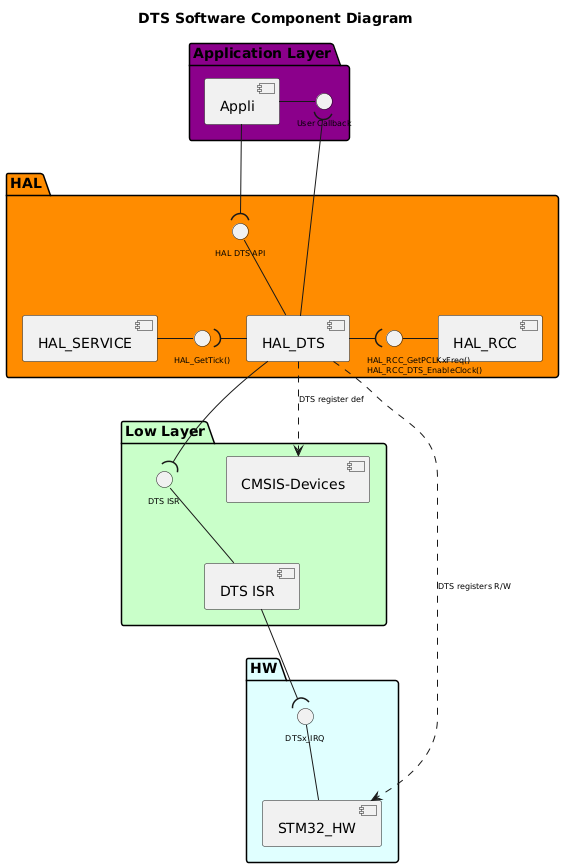
Component diagram

The following diagram illustrates the software components involved in the DTS module. It shows the interactions between the user application, HAL drivers, low-level drivers, and the hardware components.
@startuml

!$use_ppp_core = 0
!$use_ll_rcc = 0
!$use_ppp_ll = 0
!$use_ppp_hal = 1

!$use_api_itf = 1
!$use_hal_itf = 1
!$use_ll_itf = 1
!$use_core_itf = 1
!$use_hal_generic_dep = 0

!$use_ppp_isr = 1

!$use_hal_service = 1
!$use_hal_rcc = 1
!$use_hal_dma = 0
!$use_kernel_clock = 0

!$core = "XXX" + "_CORE"
!$ppp = "DTS"
!$hal_api_itf = "HAL " + $ppp + " API"
!$appli_itf = "User Callback"
!$ppp_name = "HAL_"+$ppp
!$ppp_ISR = $ppp+" ISR"
!$ll_ppp = "LL_"+$ppp

!$hal_dma_itf = "HAL_DMA_StartDirectXfer_IT_Opt()\nHAL_DMA_Abort_IT"
!if ($use_kernel_clock == 1)
!$hal_rcc_itf = "\t\t\tHAL_RCC_"+$ppp+"_GetClockFreq()\n\t\t\tHAL_RCC_"+$ppp+"_EnableClock()"
!else
!$hal_rcc_itf = "\t\t\tHAL_RCC_GetPCLKxFreq()\n\t\t\tHAL_RCC_"+$ppp+"_EnableClock()"
!endif

!$hal_ppp_itf = "Half transfer complete\nTransfer complete\nError callback\nAbort callback"

!$hal_generic_itf = "HAL_GetTick()"

!$ll_ppp_itf = "LL " + $ppp +" API"
!$ppp_xIRQ = $ppp+"x_IRQ"


<style>
componentDiagram {
arrow {
FontSize 8
}
interface {
FontSize 8
}
}
</style>

title $ppp Software Component Diagram

Package "Application Layer" #DarkMagenta {

component [Appli]
interface "$appli_itf" as APPLI_Interface
[Appli] -r- APPLI_Interface
}

package "HAL" #DarkOrange {
[$ppp_name]
!if ($use_hal_dma == 1)
interface "$hal_ppp_itf" as HAL_PPP_Interface
[$ppp_name] -d- HAL_PPP_Interface
!endif
interface "$hal_api_itf" as HAL_PPP_APPLI_Interface
[$ppp_name] -u- HAL_PPP_APPLI_Interface

!if ($use_hal_service == 1)
  [HAL_SERVICE]
  interface "$hal_generic_itf" as HAL_Service_Interface
  [HAL_SERVICE] -r- HAL_Service_Interface
  [$ppp_name] -l-( HAL_Service_Interface
!endif  
!if ($use_hal_generic_dep == 1)  
      [HAL_SERVICE]
      [$ppp_name] .r.> [HAL_SERVICE]
!endif
!if ($use_hal_dma == 1)
  [HAL_DMA]
  interface "$hal_dma_itf" as HAL_DMA_Interface
  [HAL_DMA] -u- HAL_DMA_Interface
  [HAL_DMA] -u-( HAL_PPP_Interface
  [$ppp_name] --( HAL_DMA_Interface
!endif
!if ($use_hal_rcc == 1)
  [HAL_RCC]
  interface "$hal_rcc_itf" as HAL_RCC_Interface
  [HAL_RCC] -l- HAL_RCC_Interface
  [$ppp_name] -r-( HAL_RCC_Interface
!endif
}

[Appli] -d-( HAL_PPP_APPLI_Interface
[$ppp_name] -u-( APPLI_Interface
!if ($use_ppp_core ==1)
Package "Core Layer" #Lavender{
[$core]
interface "core API" as Core_api_itf
[$core] -u- Core_api_itf
}
[$ppp_name] -d-( Core_api_itf
!endif
package "Low Layer" #Technology {
[CMSIS-Devices]
!if ($use_ppp_ll == 1)
[$ll_ppp]
interface "$ll_ppp_itf" as LL_PPP_Interface
[$ll_ppp] -u- LL_PPP_Interface
!endif

!if ($use_ppp_isr == 1) 
interface "$ppp_ISR" as PPP_ISR
[$ppp_ISR] -U- PPP_ISR
[$ppp_ISR]
!endif


!if ($use_ll_rcc == 1)
  [LL_RCC]
  interface "LL RCC API" as LL_RCC_API
  [LL_RCC] -u- LL_RCC_API
  [HAL_RCC] -d-(LL_RCC_API
!endif

!if ($use_hal_dma == 1)
  [DMA ISR]
  interface "DMA ISR" as DMA_ISR
  [DMA ISR] -u- DMA_ISR
!endif  
}

package "HW" #LightCyan {
[STM32_HW]
!if ($use_ppp_isr == 1)
interface "$ppp_xIRQ" as PPPx_IRQ
[STM32_HW] -u- PPPx_IRQ
!endif
!if ($use_hal_dma == 1)
interface "DMAx_IRQ_Ch" as DMA_IRQ_CH
[STM32_HW] -u- DMA_IRQ_CH
[DMA ISR] -d-( DMA_IRQ_CH
[HAL_DMA] --( DMA_ISR
!endif
}
!if ($use_ppp_ll == 1)
[$ppp_name] -d-( LL_PPP_Interface
[$ll_ppp] .r.> [CMSIS-Devices]: $ppp register def
[STM32_HW] <.u. [$ll_ppp] : $ppp registers R/W
!else
!if ($use_ppp_core == 1)
[$core] .l.> [CMSIS-Devices]: $ppp register def
[STM32_HW] <.u. [$core] : $ppp registers R/W
!else
[$ppp_name] .d.> [CMSIS-Devices]: $ppp register def
[STM32_HW] <.l. [$ppp_name] : $ppp registers R/W
!endif
!endif
!if ($use_ppp_isr == 1)
[$ppp_ISR] -d-( PPPx_IRQ
[$ppp_name] -d-( PPP_ISR
!endif
!if ($use_ll_rcc == 1)
[STM32_HW] <.u. [LL_RCC] : RCC registers R/W
!endif

@enduml

Configuration table

The following table lists the configuration defines for the HAL DTS module, specifying their locations, default values, and descriptions:

group DTS_Configuration_Table

Configuration inside the HAL DTS driver

Config defines

Where

Default value

Note

PRODUCT

PreProcessor env

NA

The selected device

USE_HAL_DTS_MODULE

hal_conf.h

1

Enable the HAL DTS module

USE_HAL_DTS_REGISTER_CALLBACKS

hal_conf.h

0

Allow user to define his own callback

USE_HAL_DTS_CLK_ENABLE_MODEL

hal_conf.h

HAL_CLK_ENABLE_NO

Enable the gating of the peripheral clock

USE_HAL_DTS_USER_DATA

hal_conf.h

0

Add an user data inside HAL DTS handle

USE_HAL_CHECK_PARAM

hal_conf.h

0

Enable checking of vital parameters at runtime

USE_HAL_CHECK_PROCESS_STATE

hal_conf.h

0

Enable atomic access to process state check

USE_ASSERT_DBG_PARAM

PreProcessor env

NONE

Enable check parameters for HAL

USE_ASSERT_DBG_STATE

PreProcessor env

NONE

Enable check state for HAL