HAL SDIO Use Cases

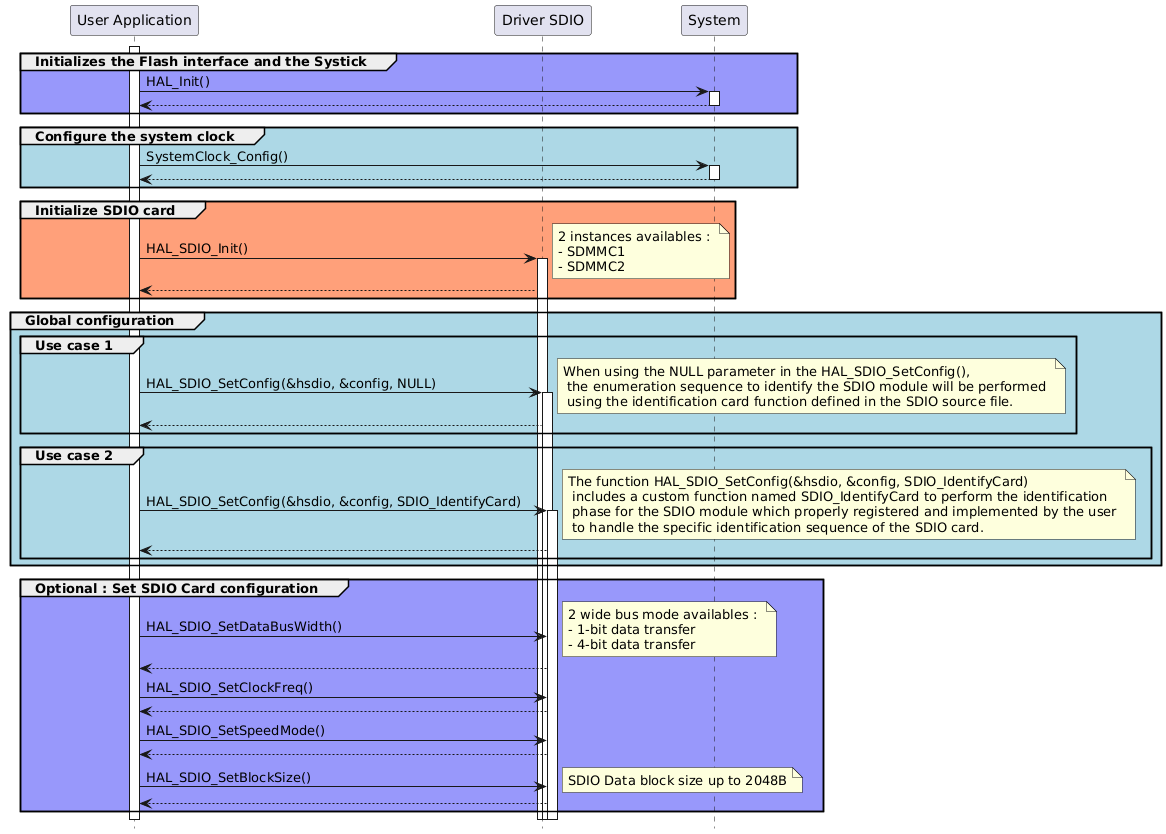
User application starting a driver with USE_HAL_SDIO_CLK_ENABLE_MODEL

@startuml
hide footbox
' To add a number by line
'autonumber

' Fix order of each column
skinparam ParticipantPadding 40

participant "User Application" as part1 
participant "Driver SDIO" as part2
participant "System" as part3

activate part1

group #9898fb Initializes the Flash interface and the Systick
part1->part3 : HAL_Init()
activate part3
part3 --> part1
deactivate part3
end

group #lightblue Configure the system clock
part1->part3 : SystemClock_Config()
activate part3
part3 --> part1
deactivate part3
end

group #lightsalmon Initialize SDIO card
part1->part2 ++ : HAL_SDIO_Init()
note right: 2 instances availables : \n- SDMMC1 \n- SDMMC2
part2 --> part1
end

group #lightblue Global configuration
group #lightblue Use case 1
part1->part2 ++ : HAL_SDIO_SetConfig(&hsdio, &config, NULL)
note right: When using the NULL parameter in the HAL_SDIO_SetConfig(), \n the enumeration sequence to identify the SDIO module will be performed \n using the identification card function defined in the SDIO source file.
part2 --> part1
end

group #lightblue Use case 2
part1->part2 ++ : HAL_SDIO_SetConfig(&hsdio, &config, SDIO_IdentifyCard)
note right: The function HAL_SDIO_SetConfig(&hsdio, &config, SDIO_IdentifyCard) \n includes a custom function named SDIO_IdentifyCard to perform the identification \n phase for the SDIO module which properly registered and implemented by the user \n to handle the specific identification sequence of the SDIO card.
part2 --> part1
end
end

group #9898fb Optional : Set SDIO Card configuration
part1->part2 : HAL_SDIO_SetDataBusWidth()
note right: 2 wide bus mode availables : \n- 1-bit data transfer \n- 4-bit data transfer
part2 --> part1
part1->part2 : HAL_SDIO_SetClockFreq()
part2 --> part1
part1->part2 : HAL_SDIO_SetSpeedMode()
part2 --> part1
part1->part2 : HAL_SDIO_SetBlockSize()
note right: SDIO Data block size up to 2048B
part2 --> part1
end
@enduml

Called functions:

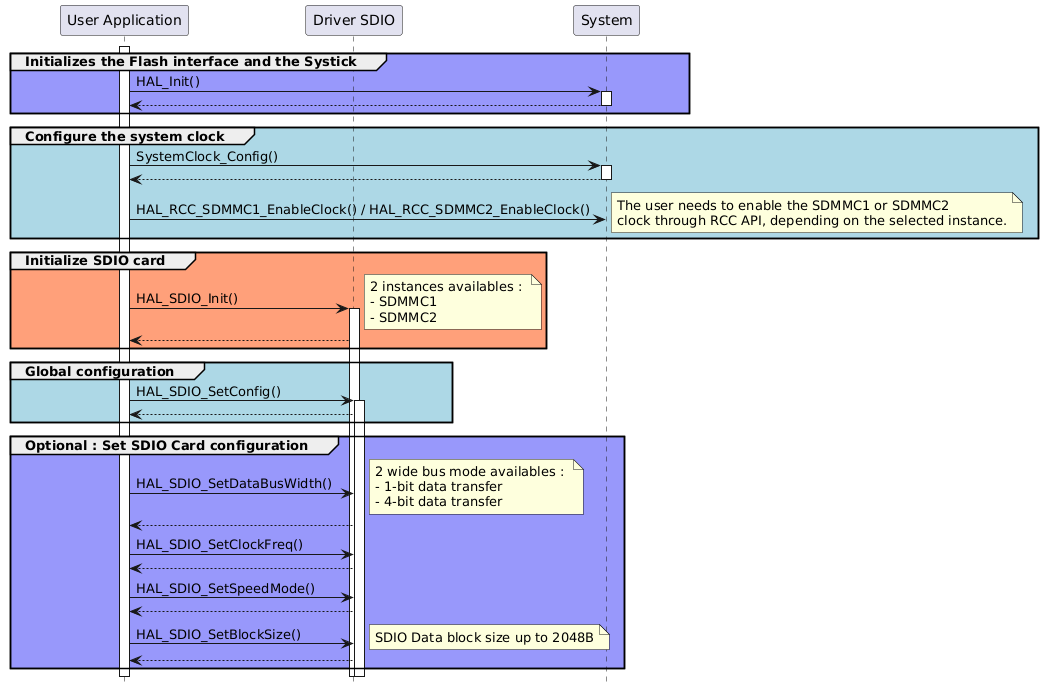
User application starting a driver without USE_HAL_SDIO_CLK_ENABLE_MODEL

@startuml
hide footbox
' To add a number by line
'autonumber

' Fix order of each column
skinparam ParticipantPadding 40

participant "User Application" as part1
participant "Driver SDIO" as part2
participant "System" as part3

activate part1

group #9898fb Initializes the Flash interface and the Systick
part1->part3 : HAL_Init()
activate part3
part3 --> part1
deactivate part3
end

group #lightblue Configure the system clock
part1->part3 : SystemClock_Config()
activate part3
part3 --> part1
deactivate part3

' Enable SDMMC clock based on selected instance
part1->part3 : HAL_RCC_SDMMC1_EnableClock() / HAL_RCC_SDMMC2_EnableClock()
note right : The user needs to enable the SDMMC1 or SDMMC2 \nclock through RCC API, depending on the selected instance.
end

group #lightsalmon Initialize SDIO card
part1->part2 ++ : HAL_SDIO_Init()
note right: 2 instances availables : \n- SDMMC1 \n- SDMMC2
part2 --> part1
end

group #lightblue Global configuration
part1->part2 ++ : HAL_SDIO_SetConfig()
part2 --> part1
end

group #9898fb Optional : Set SDIO Card configuration
part1->part2 : HAL_SDIO_SetDataBusWidth()
note right: 2 wide bus mode availables : \n- 1-bit data transfer \n- 4-bit data transfer
part2 --> part1
part1->part2 : HAL_SDIO_SetClockFreq()
part2 --> part1
part1->part2 : HAL_SDIO_SetSpeedMode()
part2 --> part1
part1->part2 : HAL_SDIO_SetBlockSize()
note right: SDIO Data block size up to 2048B
part2 --> part1
end
@enduml

Called functions:

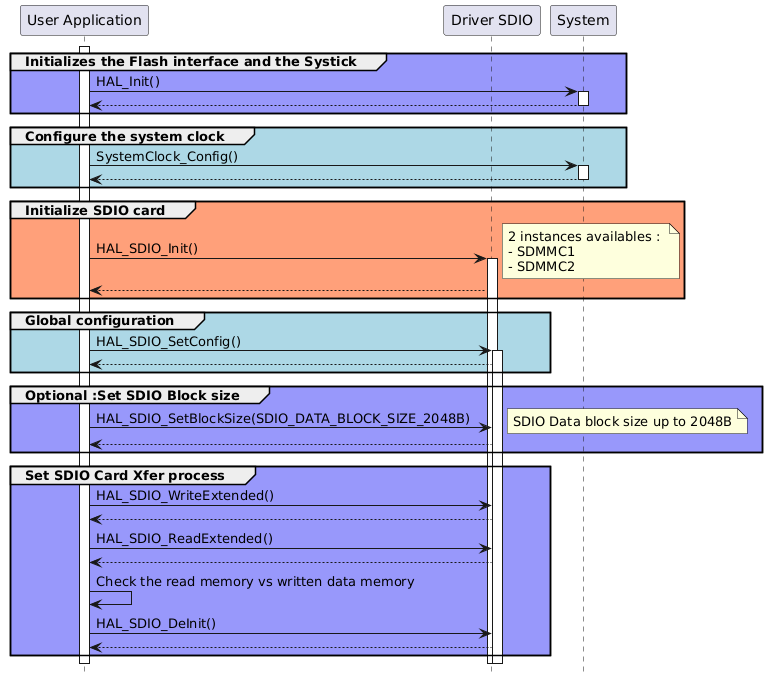
User application starting an Extended Polling transfer using Block mode

@startuml
hide footbox
participant "User Application" as part1 
participant "Driver SDIO" as part2
participant "System" as part3

activate part1

group #9898fb Initializes the Flash interface and the Systick
part1->part3 : HAL_Init()
activate part3
part3 --> part1
deactivate part3
end

group #lightblue Configure the system clock
part1->part3 : SystemClock_Config()
activate part3
part3 --> part1
deactivate part3
end

group #lightsalmon Initialize SDIO card
part1->part2 ++ : HAL_SDIO_Init()
note right: 2 instances availables : \n- SDMMC1 \n- SDMMC2
part2 --> part1
end

group #lightblue Global configuration
part1->part2 ++ : HAL_SDIO_SetConfig()
part2 --> part1
end


group #9898fb Optional :Set SDIO Block size
part1->part2 : HAL_SDIO_SetBlockSize(SDIO_DATA_BLOCK_SIZE_2048B)
note right: SDIO Data block size up to 2048B
part2 --> part1
end

group #9898fb Set SDIO Card Xfer process

part1->part2 : HAL_SDIO_WriteExtended()
part2 --> part1

part1->part2 : HAL_SDIO_ReadExtended()
part2 --> part1

part1->part1: Check the read memory vs written data memory

part1->part2 : HAL_SDIO_DeInit()
part2 --> part1
end
@enduml

Called functions:

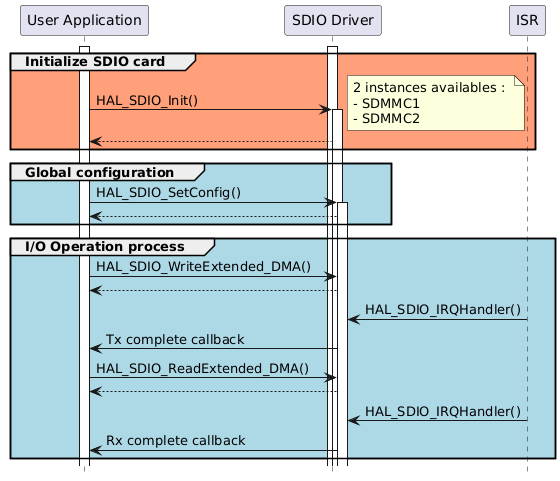
User application starting an Extended DMA transfer using block mode

@startuml
hide footbox
participant "User Application" as part1
participant "SDIO Driver" as part2
participant "ISR" as part3

activate part1
activate part2

group #lightsalmon Initialize SDIO card
part1->part2 ++ : HAL_SDIO_Init()
note right: 2 instances availables : \n- SDMMC1 \n- SDMMC2
part2 --> part1
end

group #lightblue Global configuration
part1->part2 ++ : HAL_SDIO_SetConfig()
part2 --> part1
end


group #lightblue I/O Operation process

part1->part2 : HAL_SDIO_WriteExtended_DMA()
part2 --> part1
part3 -> part2 : HAL_SDIO_IRQHandler()
part2 -> part1 : Tx complete callback

part1->part2 : HAL_SDIO_ReadExtended_DMA()
part2--> part1
part3 -> part2 : HAL_SDIO_IRQHandler()
part2 -> part1 : Rx complete callback

end 
@enduml

Called functions:

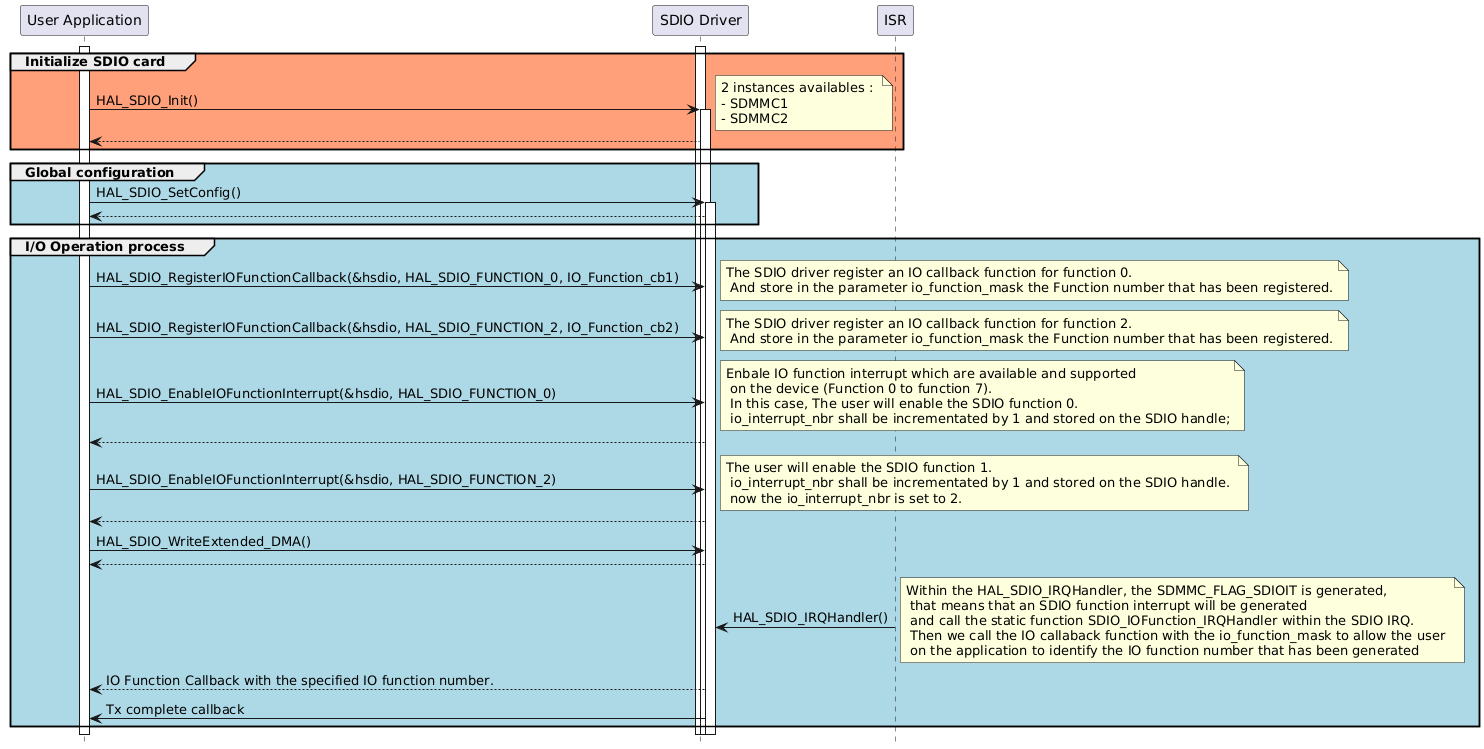
Starting an Extended DMA transfer with enabling IO Function Interrupt

@startuml
hide footbox
participant "User Application" as part1
participant "SDIO Driver" as part2
participant "ISR" as part3

activate part1
activate part2

group #lightsalmon Initialize SDIO card
part1->part2 ++ : HAL_SDIO_Init()
note right: 2 instances availables : \n- SDMMC1 \n- SDMMC2
part2 --> part1
end

group #lightblue Global configuration
part1->part2 ++ : HAL_SDIO_SetConfig()
part2 --> part1
end


group #lightblue I/O Operation process
part1->part2 : HAL_SDIO_RegisterIOFunctionCallback(&hsdio, HAL_SDIO_FUNCTION_0, IO_Function_cb1)
note right: The SDIO driver register an IO callback function for function 0. \n And store in the parameter io_function_mask the Function number that has been registered.

part1->part2 : HAL_SDIO_RegisterIOFunctionCallback(&hsdio, HAL_SDIO_FUNCTION_2, IO_Function_cb2)
note right: The SDIO driver register an IO callback function for function 2. \n And store in the parameter io_function_mask the Function number that has been registered.

part1->part2 : HAL_SDIO_EnableIOFunctionInterrupt(&hsdio, HAL_SDIO_FUNCTION_0)
note right: Enbale IO function interrupt which are available and supported \n on the device (Function 0 to function 7). \n In this case, The user will enable the SDIO function 0. \n io_interrupt_nbr shall be incrementated by 1 and stored on the SDIO handle;
part2 --> part1

part1->part2 : HAL_SDIO_EnableIOFunctionInterrupt(&hsdio, HAL_SDIO_FUNCTION_2)
note right:  The user will enable the SDIO function 1. \n io_interrupt_nbr shall be incrementated by 1 and stored on the SDIO handle. \n now the io_interrupt_nbr is set to 2.
part2 --> part1

part1->part2 : HAL_SDIO_WriteExtended_DMA()
part2 --> part1
part3 -> part2 : HAL_SDIO_IRQHandler()
note right: Within the HAL_SDIO_IRQHandler, the SDMMC_FLAG_SDIOIT is generated, \n that means that an SDIO function interrupt will be generated \n and call the static function SDIO_IOFunction_IRQHandler within the SDIO IRQ. \n Then we call the IO callaback function with the io_function_mask to allow the user \n on the application to identify the IO function number that has been generated
part2 --> part1 : IO Function Callback with the specified IO function number.
part2 -> part1 : Tx complete callback

end 
@enduml

Called functions:

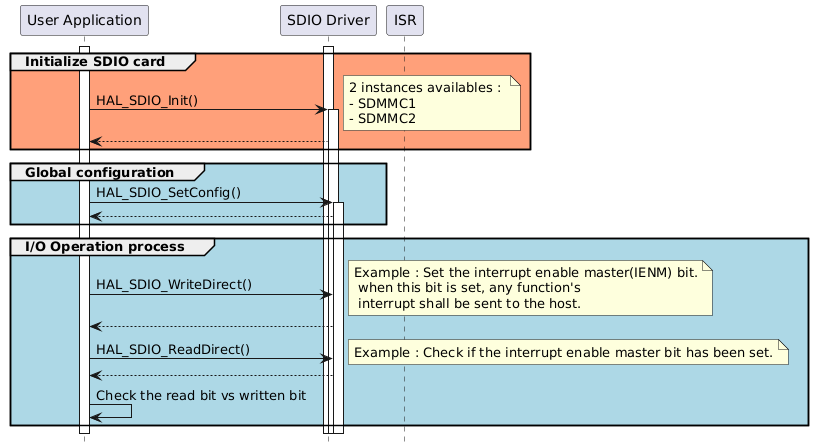
User application starting an Extended DMA transfer using block mode

@startuml
hide footbox
participant "User Application" as part1
participant "SDIO Driver" as part2
participant "ISR" as part3

activate part1
activate part2

group #lightsalmon Initialize SDIO card
part1->part2 ++ : HAL_SDIO_Init()
note right: 2 instances availables : \n- SDMMC1 \n- SDMMC2
part2 --> part1
end

group #lightblue Global configuration
part1->part2 ++ : HAL_SDIO_SetConfig()
part2 --> part1
end


group #lightblue I/O Operation process

part1->part2 : HAL_SDIO_WriteDirect()
note right: Example : Set the interrupt enable master(IENM) bit.\n when this bit is set, any function's \n interrupt shall be sent to the host. 
part2 --> part1

part1->part2 : HAL_SDIO_ReadDirect()
note right: Example : Check if the interrupt enable master bit has been set.
part2--> part1

part1 -> part1 : Check the read bit vs written bit

end 
@enduml

Called functions: