HAL SDIO Overview

Introducing SDIO

group SDIO_Introduction

  • The SDIO Hardware Abstraction Layer provides a high-level interface to the STM32 SDMMC peripheral for communicating with Secure Digital Input Output (SDIO) cards.

  • This HAL driver is built on top of the SDMMC core layer and simplifies peripheral initialization, device identification, configuration, and transition to the transfer state.

  • It supports the main data operations required by I/O applications, including direct and extended read/write transfers, function control, I/O interrupt management, and access to device status, configuration, and common or function-specific register information.

  • The driver supports polling and DMA transfer modes for data exchanges, allowing the application to balance CPU load, throughput, and responsiveness.

  • It also provides services to manage device insertion and removal events, configure transfer timing and, when available, FIFO threshold parameters.

  • This abstraction layer improves portability across STM32 devices embedding the SDMMC peripheral and eases the integration of SDIO-based peripherals into embedded applications.

Module and files

The following diagram illustrates the SDIO module and its associated files.

Module and files diagram

Component diagram

The following diagram illustrates the software components involved in the SDIO module. It shows the interactions between the user application, HAL drivers, low-level drivers, and the hardware components.
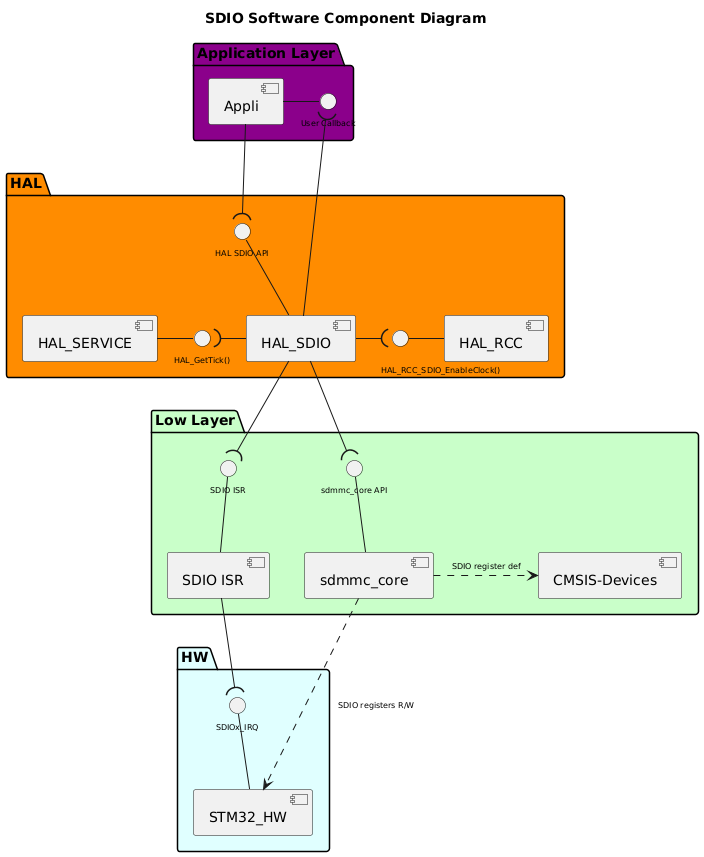

@startuml

!$use_ppp_core = 1
!$use_ppp_ll = 1
!$use_ppp_hal = 1

!$use_api_itf = 1
!$use_hal_itf = 1
!$use_ll_itf = 1
!$use_core_itf = 1

!$use_ppp_isr = 1

!$use_hal_service = 1
!$use_hal_rcc = 1
!$use_hal_dma = 0

!$use_ll_rcc = 0

!$ppp    = "SDIO"
!$ppp_lc = "sdio"
!$hal_api_itf = "HAL " + $ppp + " API"
!$appli_itf = "User Callback"
!$ppp_name = "HAL_"+$ppp
!$ppp_ISR = $ppp+" ISR"
!$core_ppp = "sdmmc_core"
!$hal_dma_itf = "HAL_DMA_StartDirectXfer()\nHAL_DMA_Abort_IT"
!$hal_rcc_itf = "\n\t\t\t\tHAL_RCC_"+$ppp+"_EnableClock()"
!$hal_ppp_itf = "DMA CallBacks\nDMA Half transfer complete CallBack\nError CallBacks"
!$hal_generic_itf = "HAL_GetTick()"
!$core_ppp_itf = $core_ppp +" API"
!$ppp_xIRQ = $ppp+"x_IRQ"

<style>
componentDiagram {
arrow {
FontSize 8
}
interface {
FontSize 8
}
}
</style>

title $ppp Software Component Diagram

Package "Application Layer" #DarkMagenta {

component [Appli]
interface "$appli_itf" as APPLI_Interface
[Appli] -r- APPLI_Interface
}

package "HAL" #DarkOrange {
[$ppp_name]
!if ($use_hal_dma == 1)
interface "$hal_ppp_itf" as HAL_PPP_Interface
[$ppp_name] -d- HAL_PPP_Interface
!endif
interface "$hal_api_itf" as HAL_PPP_APPLI_Interface
[$ppp_name] -u- HAL_PPP_APPLI_Interface

!if ($use_hal_service == 1)
  [HAL_SERVICE]
  interface "$hal_generic_itf" as HAL_Service_Interface
  [HAL_SERVICE] -r- HAL_Service_Interface
  [$ppp_name] -l-( HAL_Service_Interface
!endif  

!if ($use_hal_dma == 1)
  [HAL_DMA]
  interface "$hal_dma_itf" as HAL_DMA_Interface
  [HAL_DMA] -u- HAL_DMA_Interface
  [HAL_DMA] -u-( HAL_PPP_Interface
  [$ppp_name] --( HAL_DMA_Interface
!endif
!if ($use_hal_rcc == 1)
  [HAL_RCC]
  interface "$hal_rcc_itf" as HAL_RCC_Interface
  [HAL_RCC] -l- HAL_RCC_Interface
  [$ppp_name] -r-( HAL_RCC_Interface
!endif
}

[Appli] -d-( HAL_PPP_APPLI_Interface
[$ppp_name] -u-( APPLI_Interface

package "Low Layer" #Technology {

!if ($use_ppp_ll == 1)
  [$core_ppp]
  interface "$core_ppp_itf" as LL_PPP_Interface
  [$core_ppp]  -u- LL_PPP_Interface
!endif 

!if ($use_ppp_isr == 1) 
interface "$ppp_ISR" as PPP_ISR
[$ppp_ISR] -U- PPP_ISR
[$ppp_ISR]
!endif

[CMSIS-Devices]
!if ($use_ll_rcc == 1)
  [LL_RCC]
  interface "LL RCC API" as LL_RCC_API
  [LL_RCC] -u- LL_RCC_API
  [HAL_RCC] -d-(LL_RCC_API
!endif

!if ($use_hal_dma == 1)
  [DMA ISR]
  interface "DMA ISR" as DMA_ISR
  [DMA ISR] -u- DMA_ISR
!endif  
}

package "HW" #LightCyan {
[STM32_HW]
!if ($use_ppp_isr == 1)
interface "$ppp_xIRQ" as PPPx_IRQ
[STM32_HW] -u- PPPx_IRQ
!endif
!if ($use_hal_dma == 1)
interface "DMAx_IRQ_Ch" as DMA_IRQ_CH
[STM32_HW] -u- DMA_IRQ_CH
[DMA ISR] -d-( DMA_IRQ_CH
[HAL_DMA] --( DMA_ISR
!endif
}
!if ($use_ppp_ll == 1)
[$ppp_name] -d-( LL_PPP_Interface
[$core_ppp] .r.> [CMSIS-Devices]: $ppp register def
[STM32_HW] <.u. [$core_ppp] : $ppp registers R/W
!else
[$ppp_name] .d.> [CMSIS-Devices]: $ppp register def
[STM32_HW] <.l. [$ppp_name] : $ppp registers R/W
!endif
!if ($use_ppp_isr == 1)
[$ppp_ISR] -d-( PPPx_IRQ
[$ppp_name] -d-( PPP_ISR
!endif
!if ($use_ll_rcc == 1)
[STM32_HW] <.u. [LL_RCC] : RCC registers R/W
!endif

@enduml

Configuration table

The following table lists the configuration defines for the HAL SDIO module, specifying their locations, default values, and descriptions:

group SDIO_Configuration_Table

Configuration inside the SDIO driver

Config defines

Description

Default value

Note

USE_ASSERT_DBG_PARAM

from the IDE

NONE

Allows to use the assert checks parameters.

USE_ASSERT_DBG_STATE

from the IDE

NONE

Allows to use the assert checks states.

USE_HAL_CHECK_PARAM

from hal_conf.h

0

Allows to use the run-time checks parameters.

USE_HAL_SDIO_REGISTER_CALLBACKS

from hal_conf.h

0

Allows to provide specific callback functions.

USE_HAL_SDIO_GET_LAST_ERRORS

from hal_conf.h

0

Allows to get last errors codes.

USE_HAL_SDIO_USER_DATA

from hal_conf.h

0

Allows to enable/disable user data.

USE_HAL_SDIO_CLK_ENABLE_MODEL

from hal_conf.h

HAL_CLK_ENABLE_NO

Allows to enable the clock model for the SDIO.